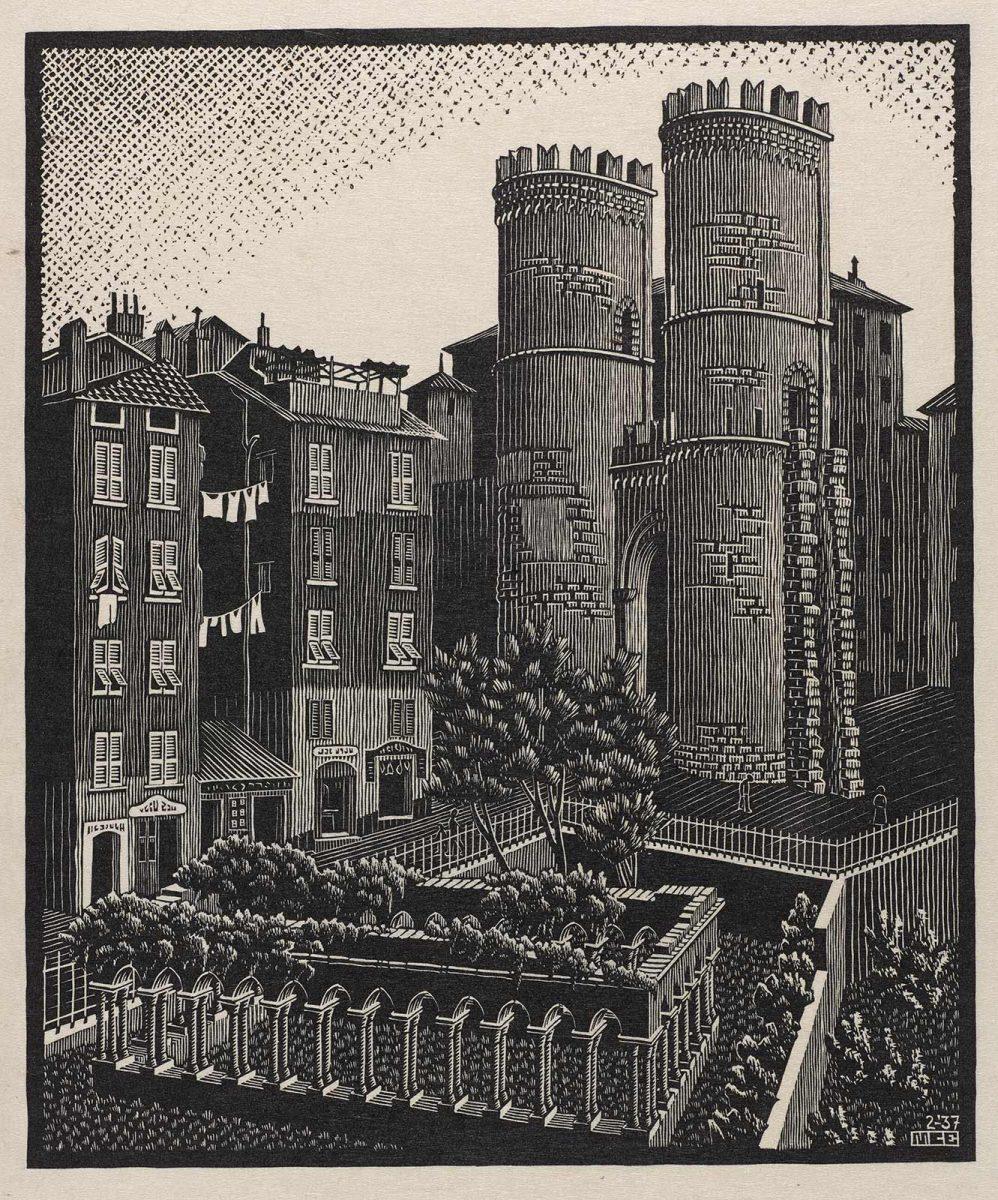
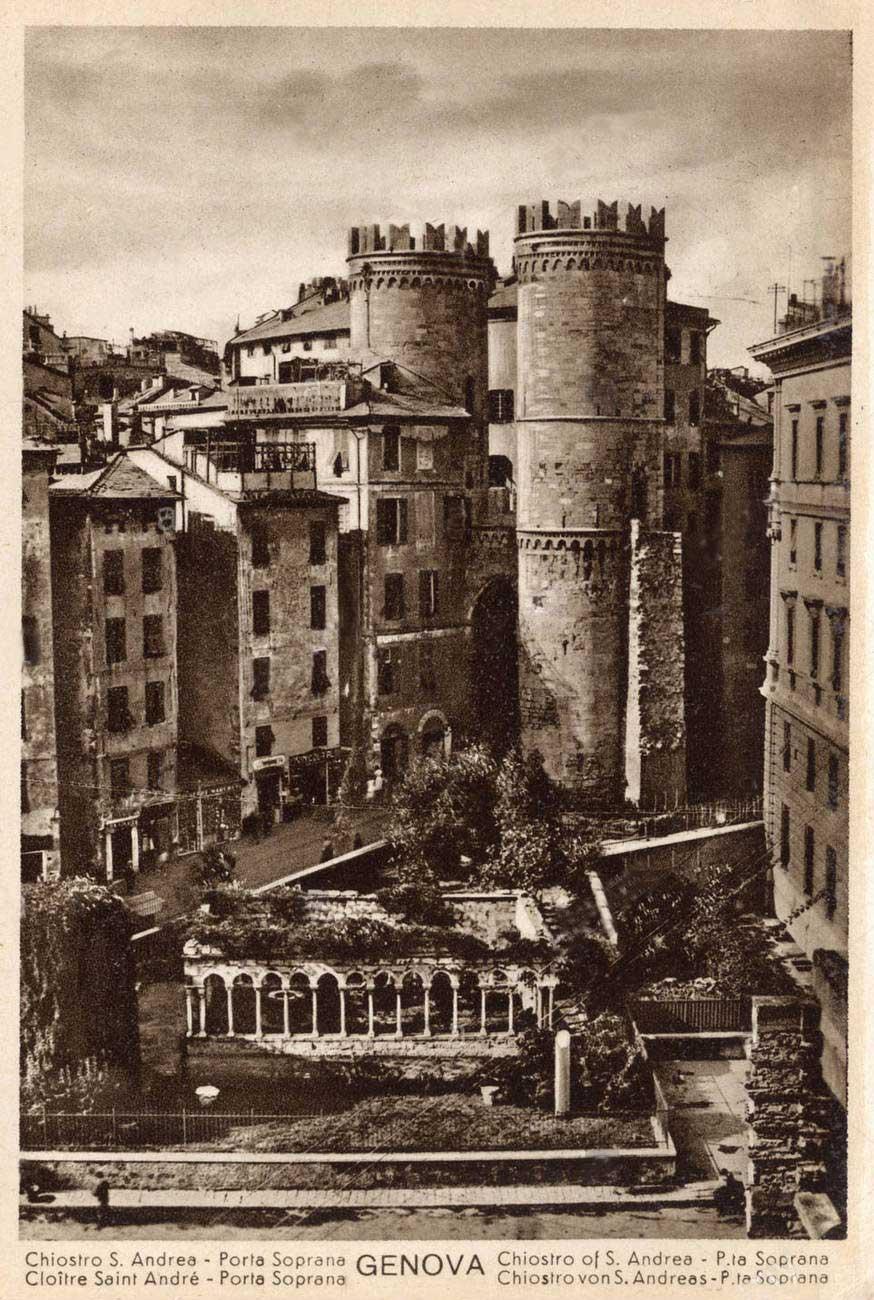
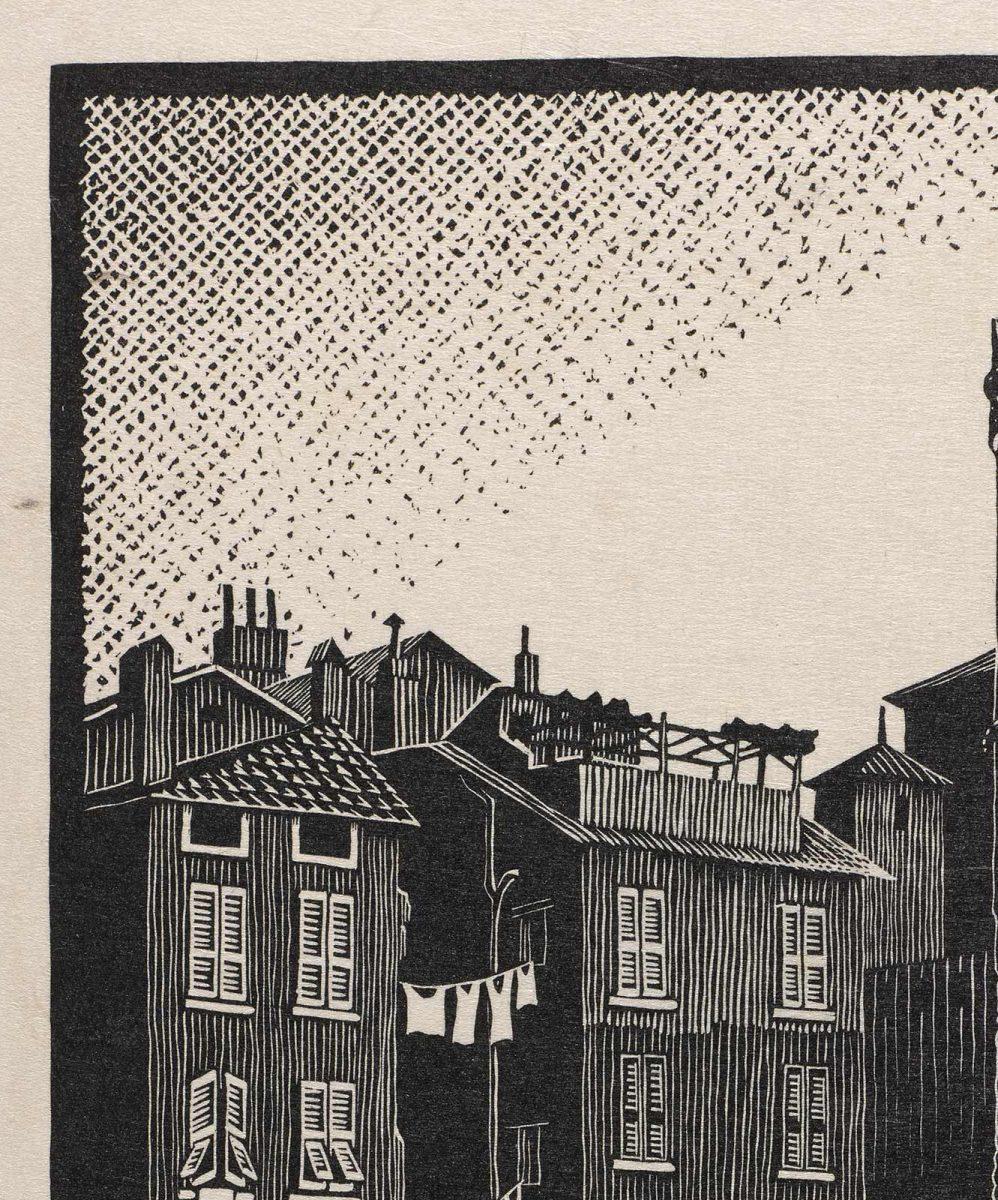
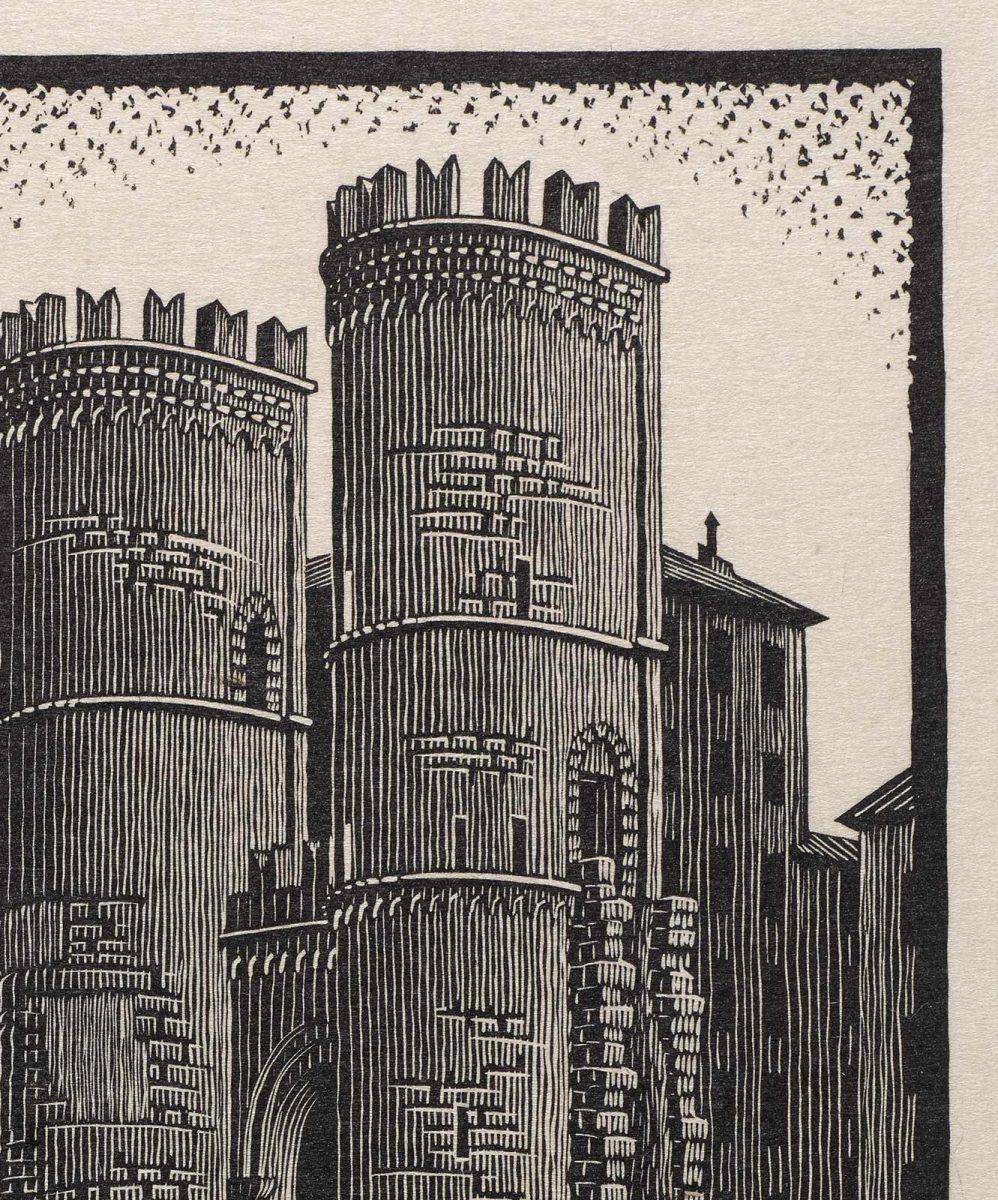
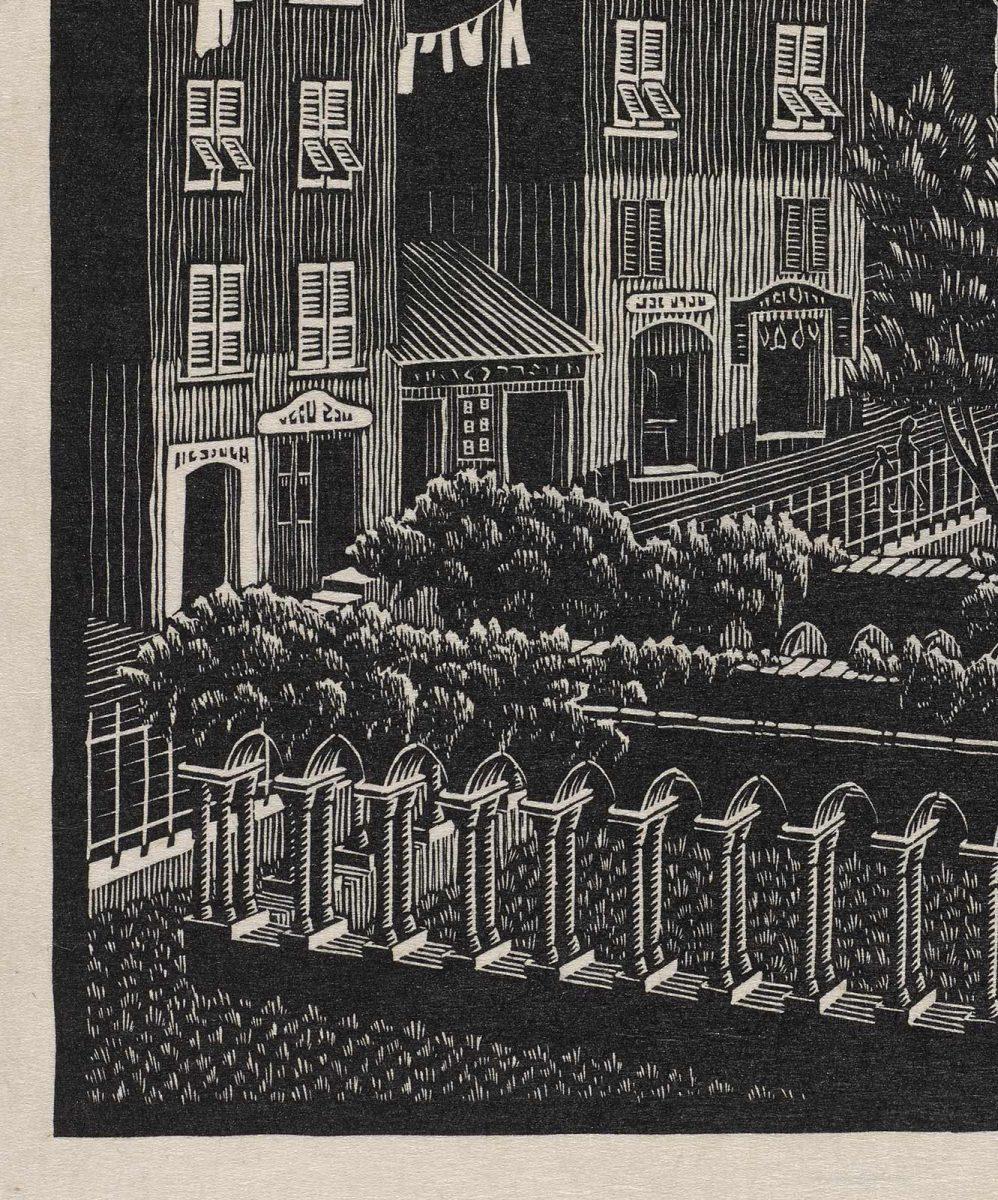
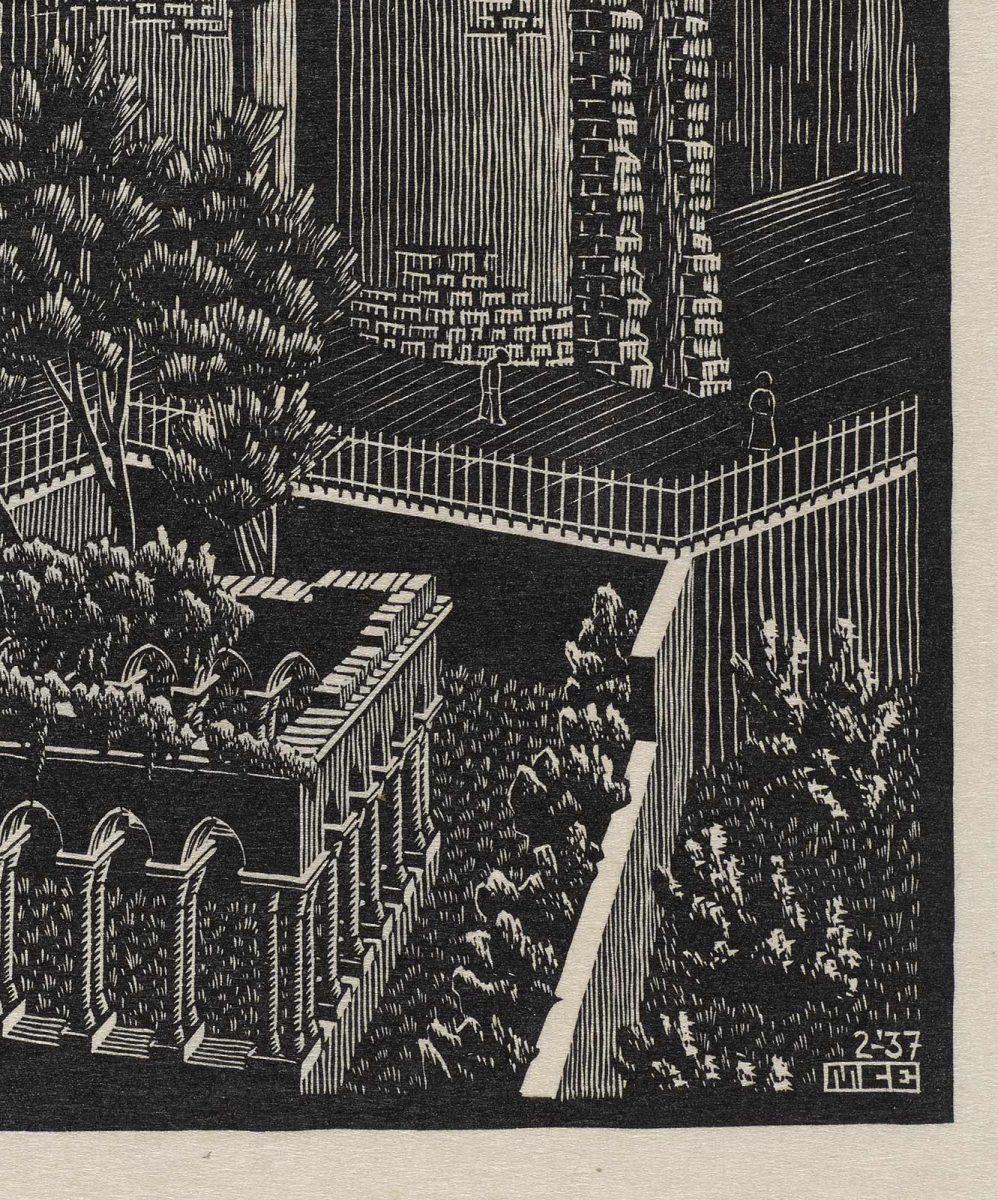
The Piano di Sant'Andrea is an historic site of ancient Genoa situated on top of a hill of the same name. In the Middle Ages, this was an essential gateway to the city. At the foot of the towers lies the birthplace of Christopher Columbus. Escher visited Genoa and the Piano di Sant'Andrea in the spring of 1936, when he (partially together with his wife, Jetta) made a voyage across the Mediterranean Sea, a journey that brought him considerable pleasure, but also much inspiration. He took photographs and made drawings that he later developed in wood or on stone for the purpose of printing.. This included woodcuts featuring Venice, Ancona, the tower of Pisa and the cargo ship on which they travelled, wood engravings of Catania and Marseille and a lithograph of Nunziata on Sicily. Besides, the journey was a source of inspiration for one of his first optical illusions: Still life and street. In February 1937 he made this woodcut of the Piano di Sant'Andrea.

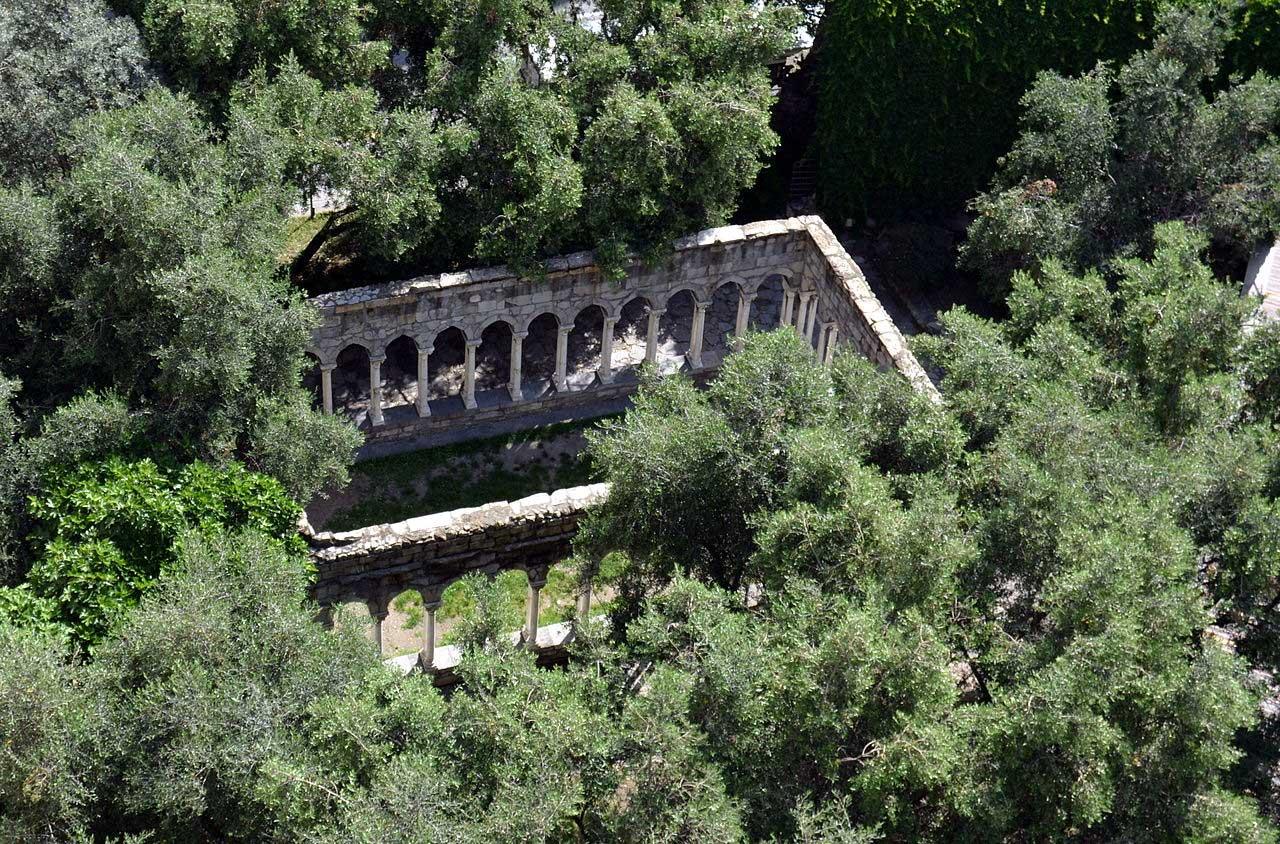
As in the prints San Michele dei Frisoni and St. Peter’s from the Gianicolo, Escher emphasises natural elements in the foreground and positions the buildings behind them. He creates a cityscape, but that does not mean that nature must be absent from the scene. In this case, he depicted what he saw, because there is a park on Piazza Dante, the square at the foot of Porta Soprana. Hidden in this park are the ruins of what was once the cloister of St. Andrew. He made the drawing that was the foundation for the woodcut while at the elevated terrace of the post office, diagonally opposite the gate, for which he had to request permission to gain access to the terrace.


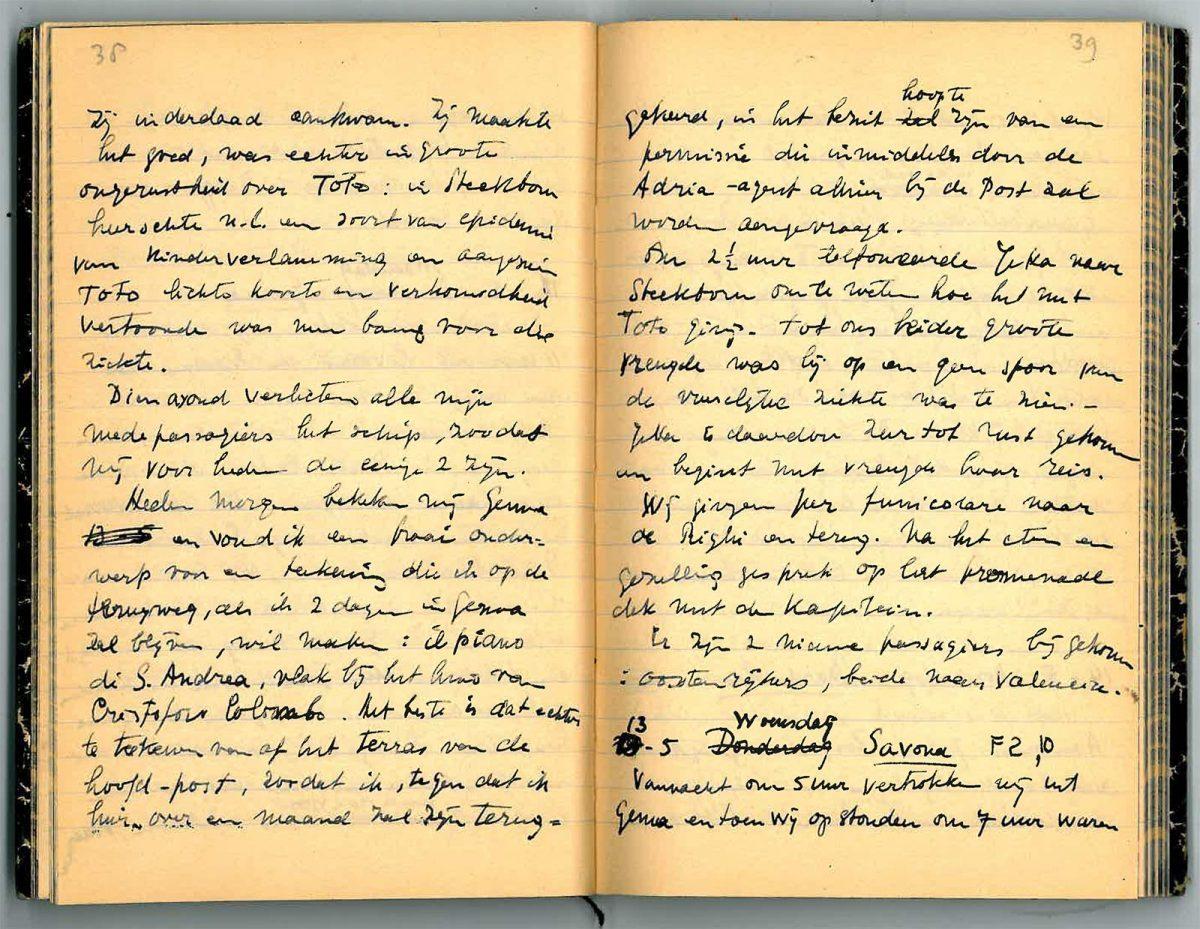
In the diary he kept during the 1936 trip, he wrote:
'This morning (12 May 1936, EK), we visited Genoa and I found a beautiful subject for a drawing I would like to make on my return trip, when I stay in Genoa for two days: il piano di S. Andrea, located close to the Christopher Columbus house. It would be best to draw from the terrace of the main tower, so once I have returned, I hope to have been granted the access requested by mail by the Adria representative stationed here.'


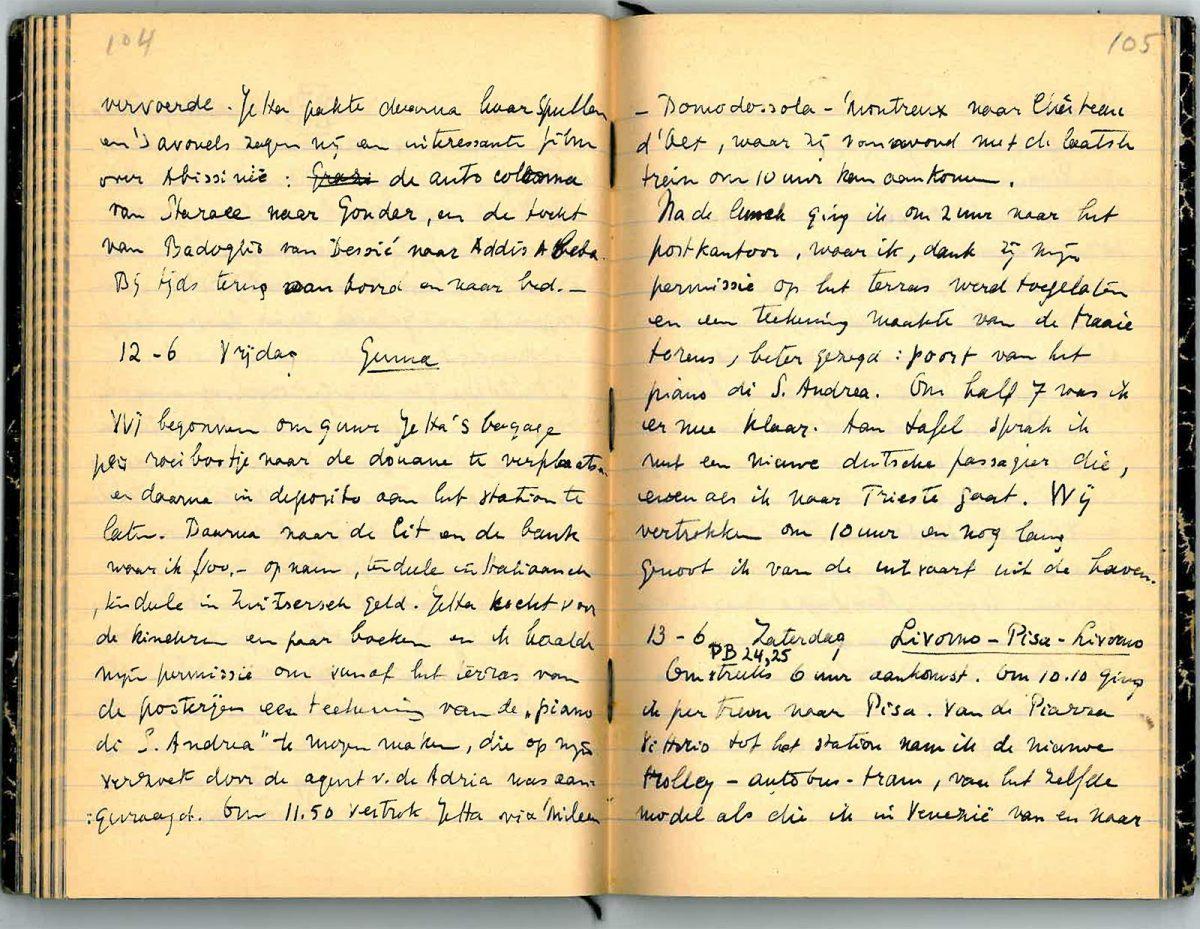
Maurits and Jetta then travelled to Spain and returned to Genoa on 10 June 1936. The next day, public life in the city came to a halt due to the Christian Corpus Domini celebration. They watched a long procession of ‘countless congregations, schools, seminars and all kinds of religious associations’. In the afternoon, they took a long walk through the city. Jetta left for home the next day, while Maurits continued on a sea voyage around Italy, he would return to Château-d’Oex on 27 June. His diary entry of 12 June states:
'..I received permission to make a drawing of the 'piano di S. Andrea' from the terrace of the post office, as requested on my behalf by the Adria representative. At 11:50 am, Jetta left to travel via Milan-Domodossola-Montreux to Château-d’Oex, where she will arrive on the last train at 10 am.
After lunch, I went to the post office where, thanks to my permission, I was allowed access to the terrace, where I created a drawing of the beautiful towers, or should I say gates of the piano di S. Andrea. I finished it at half past 6.'
Map is loading...


More Escher today

Development I