This website uses cookies

We use cookies and similar technologies on this website to analyze visits and to show you relevant messages on social media. By clicking 'Accept all' you give permission for their placement and for the processing of personal data obtained in this way, as stated in our privacy & cookie statement.

Our privacy & cookie statement:

Fool the eye
31 January 2026

Fool the eye

There has always been great interest worldwide in M. C. Escher's work. Articles about him and his art often speak of 'optical illusions’ and his work is almost automatically associated with that term. Understandable, even though the relationship between optical illusions and Escher's work differs from how optical illusions are generally explained.

An optical illusion is an image that our eyes perceive but which our brains interpret incorrectly. Human perception is susceptible to these visual deceptions. And that susceptibility is something that artists have tapped into for centuries; Escher is a particularly good example of that. The attraction of many of his prints can be found in the fact that they suggest things that don't exist. They are illusions which have been perfectly rationalised and which fit within his themes. Escher uses prevailing laws of nature to achieve the illusion. People interpret the world around them through their senses and their brains. The combination of eyes and brain is particularly defining. The retina, which is how the world enters our brain, is the window. The eyes do not distinguish between looking at a real cube or a drawing of a cube, for example.

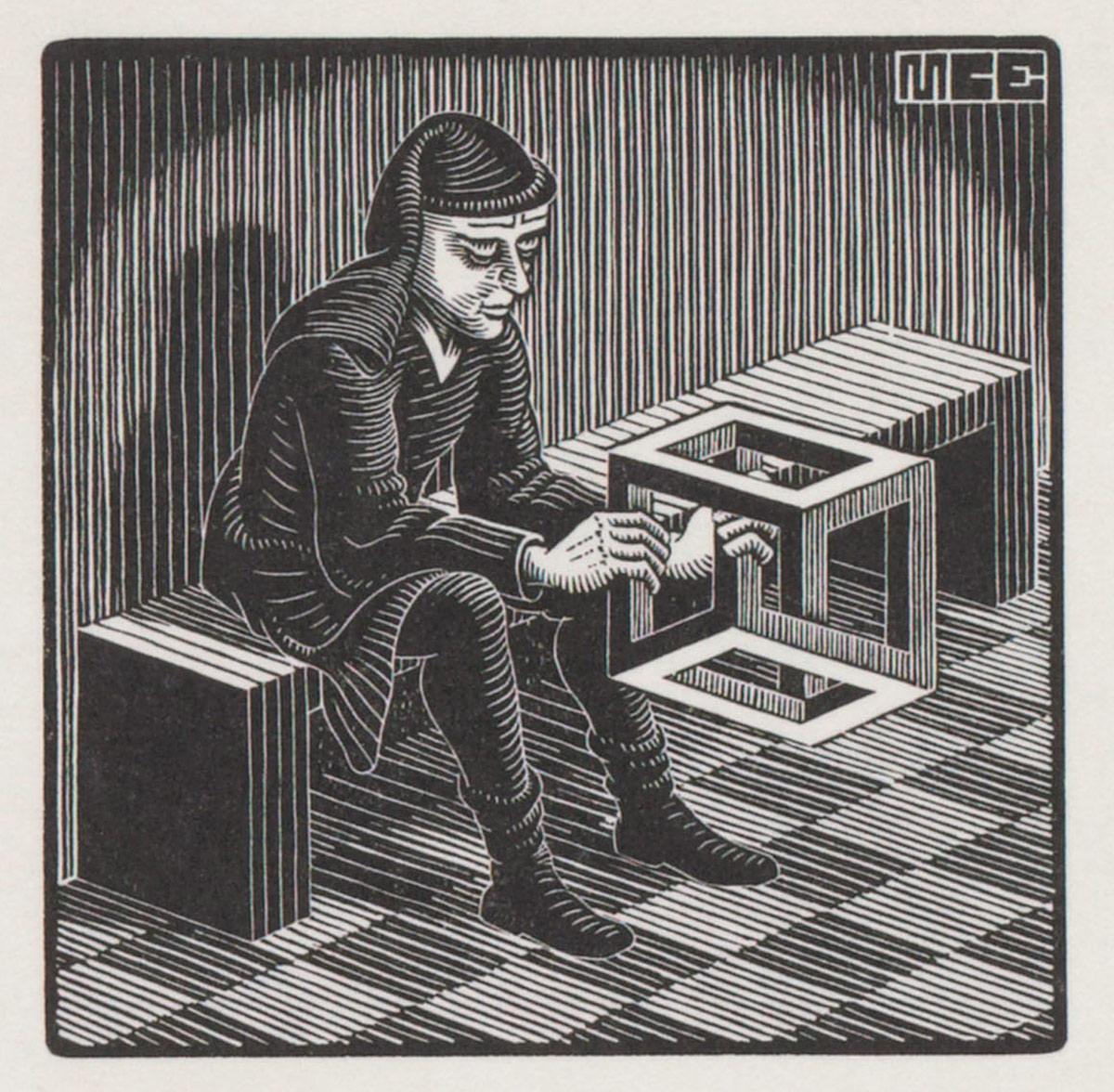
The spatial experience of the cube only starts when the brain converts that flat image into a three-dimensional form. 2D becomes 3D. The conversion from flat to spatial is something that always fascinated Escher and he used it in his prints time and time again. He was well aware that this conversion happens automatically and that you, the viewer, can't stop it.

<p>M.C. Escher, Man with cuboid, wood engraving, 1958</p>

M.C. Escher, Man with cuboid, wood engraving, 1958

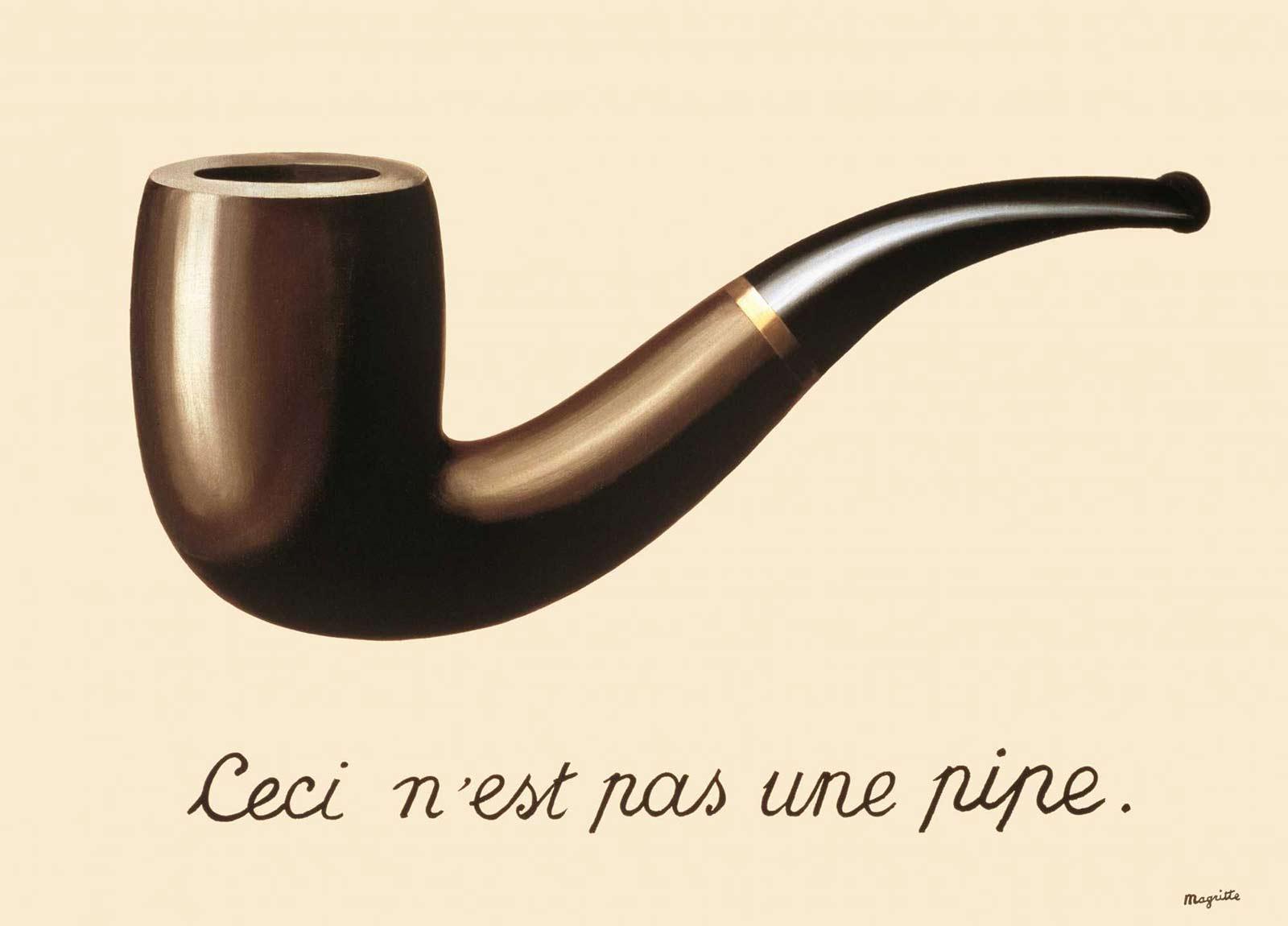
<p>René Magritte, The Treachery of Images, 1929. Oil on canvas. Collection: Los Angeles County Museum of Art, Museum Associates/LACMA, Licensed by Art Resource, NY<br>&nbsp;</p>

René Magritte, The Treachery of Images, 1929. Oil on canvas. Collection: Los Angeles County Museum of Art, Museum Associates/LACMA, Licensed by Art Resource, NY
 

A huge grey area arises between reality and illusion, due to this automated collaboration between brain and eye. After all, you can claim that every image based on reality, a portrait or a landscape for example, is an illusion. That applies even, or specifically, to works of art from the hyper-realism period that existed towards the end of the 1960s, with its images that appear to be realistic but are not. It is not that person, but rather a two-dimensional depiction attempting to animate that person as far as possible. With The Treachery of Images, René Magritte (1898 - 1967) created an actual reference to that illusion. He painted a pipe, with the caption 'Ceci n'est pas une pipe' and with that, hammers home the message: this is not a real pipe, but an image of a pipe. So a real difference can be perceived in the depiction of that reality and the artist's intentions. It only becomes an optical illusion if it is the artist's intention to mislead the public.

Reality versus unreality

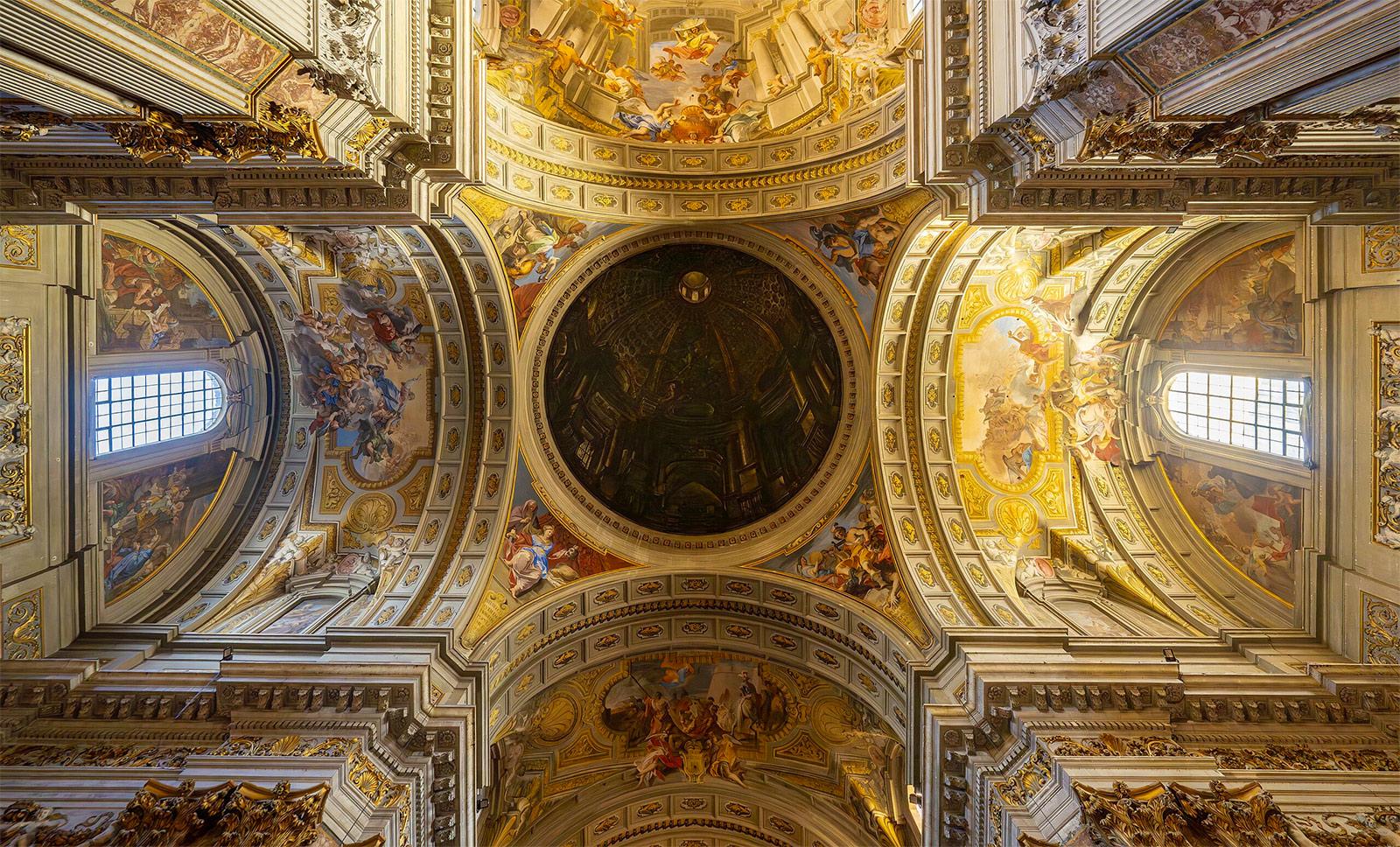
The earliest example in the arts of this intention is trompe-l’oeil ("to fool the eye’’). The aim is to have the viewer believe what they see, even though what they see isn't what they believe it to be. As long ago as the classical antiquity, this form of visual illusion was highly regarded; it is after all proof of the maker's talent if they are able to create a perfect illusion. It requires an exceptional mastery of the techniques, such as applying perspective and shadow effect, detailing and reproduction of materials. As far back as 500 BC, Greek artist Zeuxis was apparently able to paint grapes so realistically that birds tried to eat them*. Trompe-l’oeil made a comeback in the Italian Renaissance in the form of painted ceilings and murals in which the outside world appeared to be gatecrashing, depicting clouds and peeping angels.

<p>Andrea Pozzo, trompe-l’oeil ceiling in the Sant'Ignazio church in Rome, 1865. Photo: Fiat 500e, CC BY 4.0, via Wikimedia Commons</p>

Andrea Pozzo, trompe-l’oeil ceiling in the Sant'Ignazio church in Rome, 1865. Photo: Fiat 500e, CC BY 4.0, via Wikimedia Commons

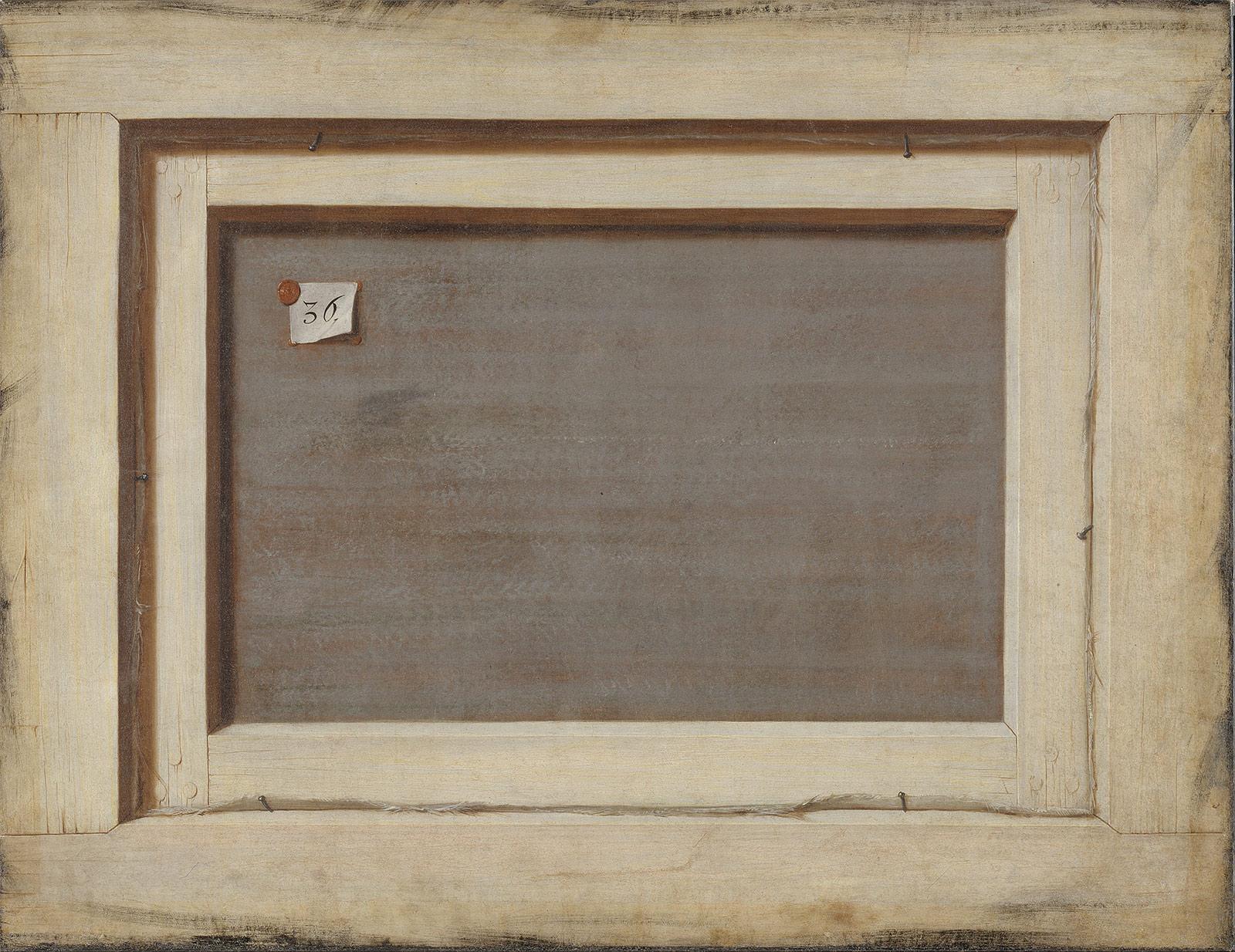
<p>Cornelis Gijsbrechts, The Reverse of a Framed Painting, oil on canvas, 1670. Collection: Statens Museum for Kunst, Kopenhagen</p>

Cornelis Gijsbrechts, The Reverse of a Framed Painting, oil on canvas, 1670. Collection: Statens Museum for Kunst, Kopenhagen

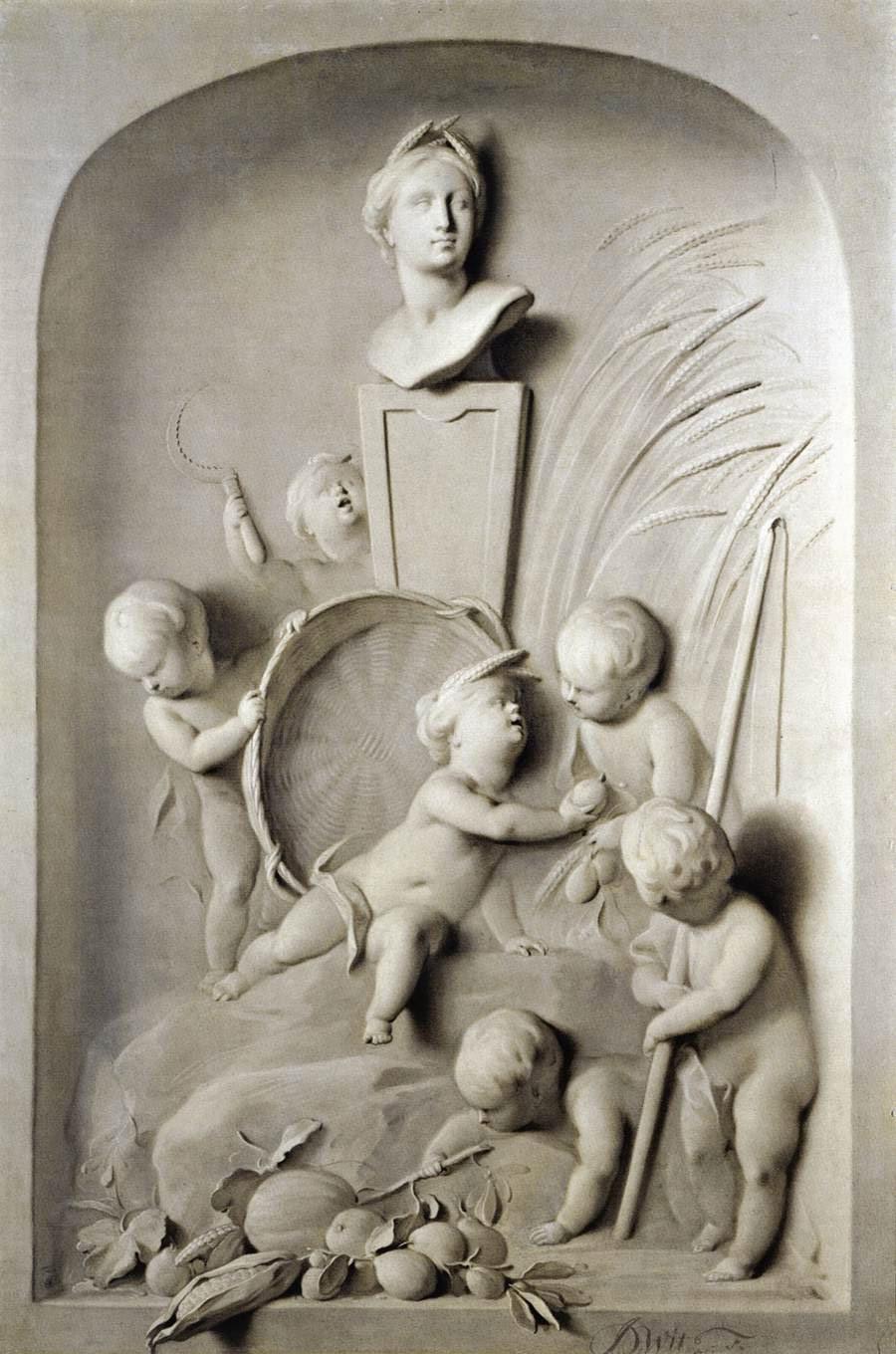
In the Netherlands too, artists such as Rembrandt van Rijn (1606 -1669) and his pupil Samuel van Hoogstraten (1627 - 1678) created trompe-l'oeil works. For Rembrandt, these works formed a means of displaying his craftsmanship, while Van Hoogstraten actually specialised in the genre. With The Reverse of a Framed Painting another of Escher's contemporaries, Cornelius Gijsbrechts (1630 - 1684), painted a trompe-l’oeil that is often seen as a very early example of conceptual art, due to the subject. Throughout the Baroque period, this art form remained popular, for example in painted church ceilings that create the illusion that they are opened to the heavens. Internationally famous artists in that field were Giovanni Battista Gaulli (1639–1709) and Andrea Pozzo (1642–1709). In the Netherlands, they were joined by Gerard de Lairesse (1640–1711) and Jacob de Wit (1695–1754). A sub-genre of the trompe-l’oeil is the grisaille: this is a relief that is painted mainly in grey tones and looks particularly realistic. De Wit also painted them in white, resulting in them being called 'witjes' (since white is called 'wit' in Dutch, the same as his surname).

<p>Jacob de Wit, Summer, oil on canvas, 1751. Collection Staatliche Museen, Schloss Wilhelmshöhe, Kassel</p>

Jacob de Wit, Summer, oil on canvas, 1751. Collection Staatliche Museen, Schloss Wilhelmshöhe, Kassel

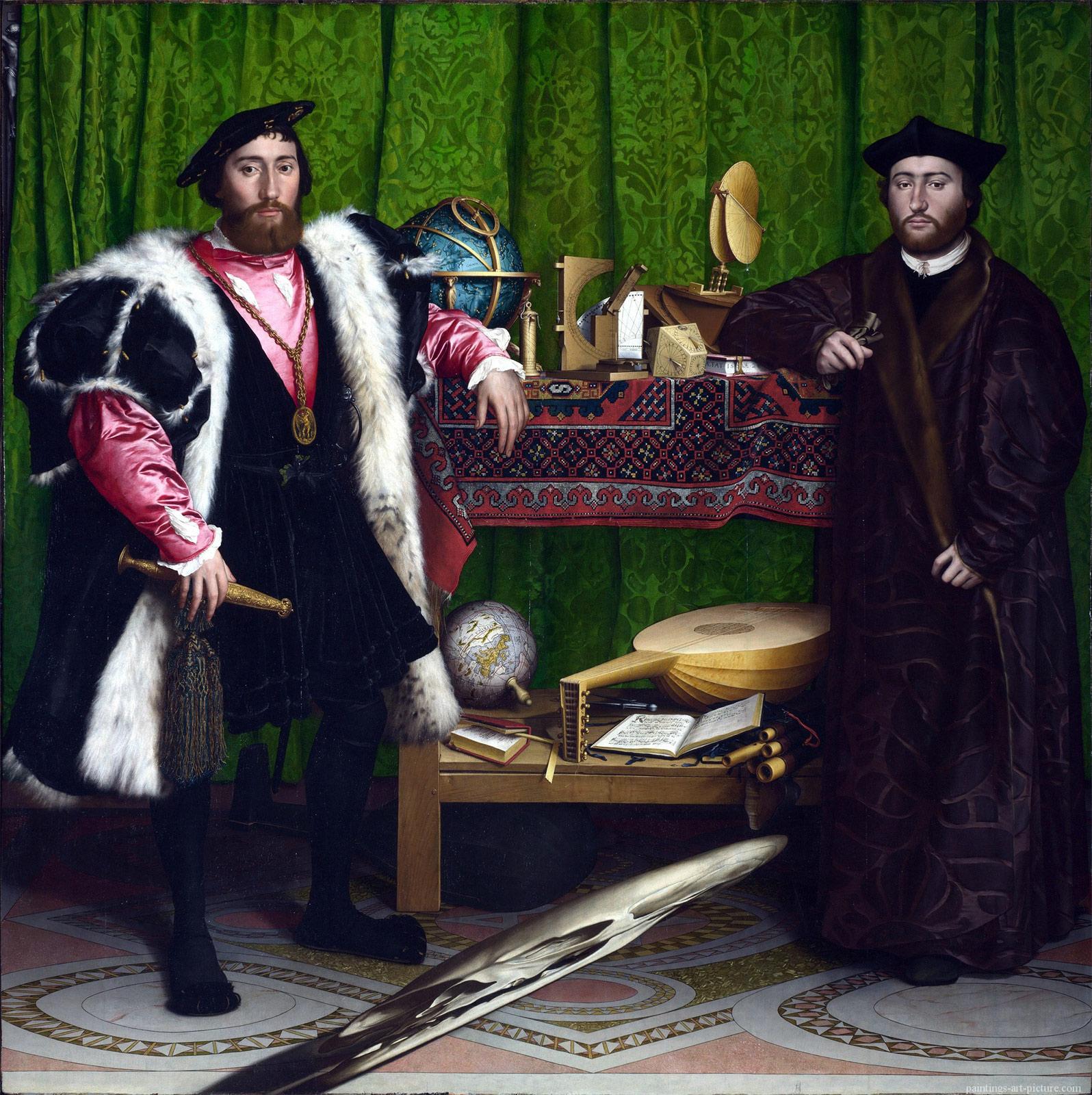
<p>Hans Holbein, The Ambassadors, oil on wood, 1533. Collection National Gallery, Londen<br>&nbsp;</p>

Hans Holbein, The Ambassadors, oil on wood, 1533. Collection National Gallery, Londen
 

Anamorphosis, related to trompe-l’oeil, is a distorted image that can only be recognised from a specific viewpoint or through a mirror. Such mirrors are often cylindrical, but also sometimes in the form of a cone or pyramid. Leonardo da Vinci (1452 - 1519) was the first to experiment with that, and the technique continued to be perfected in the Renaissance.** Anamorphoses were popular because the maker could hide a message in them that required some effort to see. One high point in this genre is The Ambassadors by Hans Holbein (1497/1498 - 1543), in which a skull can be seen from a certain angle. Escher saw the painting in July 1957, when visiting the National Gallery, and was very impressed by it.***

Perspective is an important technique in creating an illusion. It makes many demands of the automated collaboration between brain and eye. The simplest example of this automation is two vertical lines that draw nearer each other towards the top, where there is a horizontal line. This is automatically interpreted as a road, a railway or a waterway going towards the horizon. The first attempts at perspective were made in ancient Greece, but the technique wasn't established until Filippo Brunelleschi (1377 - 1446) carried out a series of experiments around 1425. The first book on this subject was written by Leon Battista Alberti (1404 - 1472) in 1435. In that period, Leonardo da Vinci and Andrea Mantegna (1431 - 1506) succeeded in perfecting perspective. 
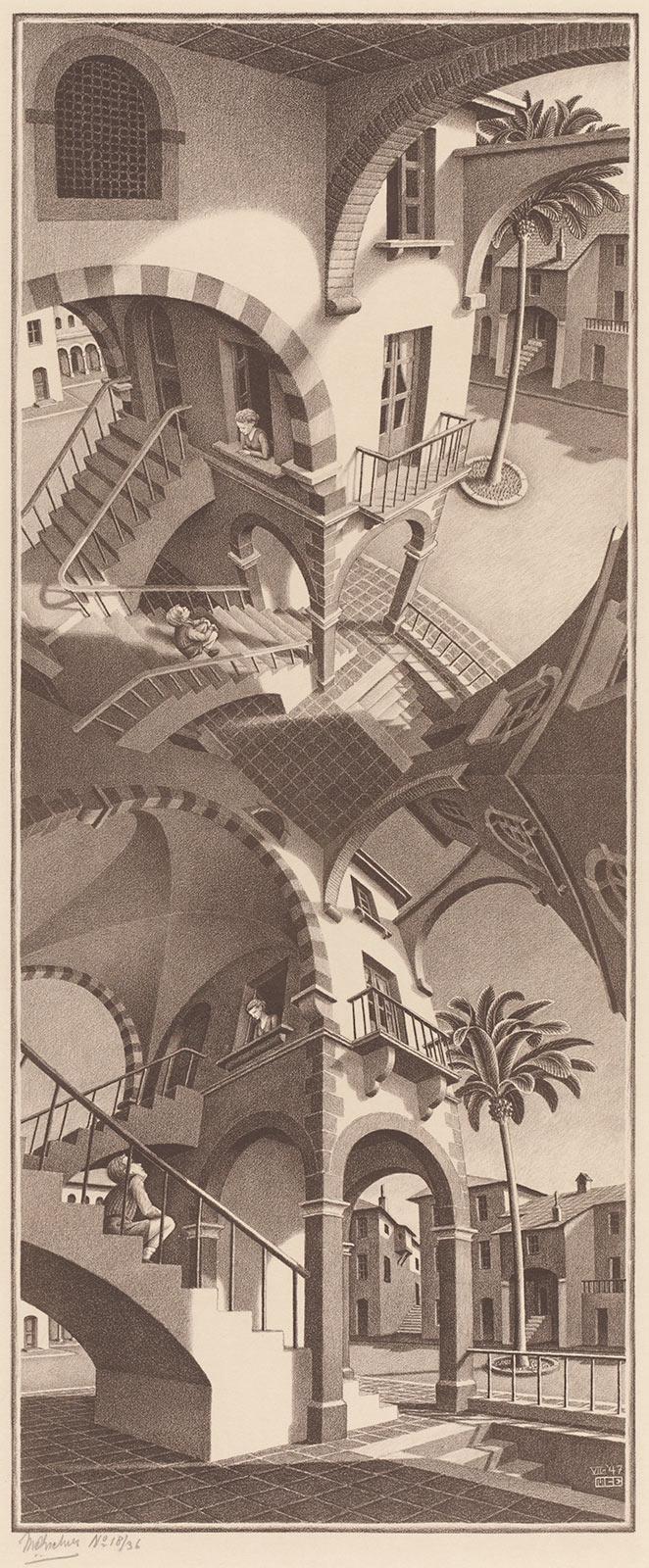
<p>M.C. Escher, Up and Down, lithograph, July 1947</p>

M.C. Escher, Up and Down, lithograph, July 1947

But although those artists were aware that perspective is in fact a trick, the use of it served a clear objective: to depict reality as realistically as possible on a flat plane. For Escher too, the automatism with which perspective is interpreted, was an important source for the themes in his work, to allow something non-existent to appear real. In Relativity, he uses the viewer's conditioned behaviour by uniting multiple perspectives in a single print. He uses a variant of this in Up and Down in which he introduces curved perspective lines to combine the frog and bird perspective.

<p>William Hogarth, Satire on False Perspective, engraving, 1754. Collection Metropolitan Museum New York<br>The text below the image:<br>Whoever makes a DESIGN without the Knowledge of PERSPECTIVE will be liable to such Absurdities as are shewn in this Frontiſpiece [frontispiece].</p>

William Hogarth, Satire on False Perspective, engraving, 1754. Collection Metropolitan Museum New York
The text below the image:
Whoever makes a DESIGN without the Knowledge of PERSPECTIVE will be liable to such Absurdities as are shewn in this Frontiſpiece [frontispiece].

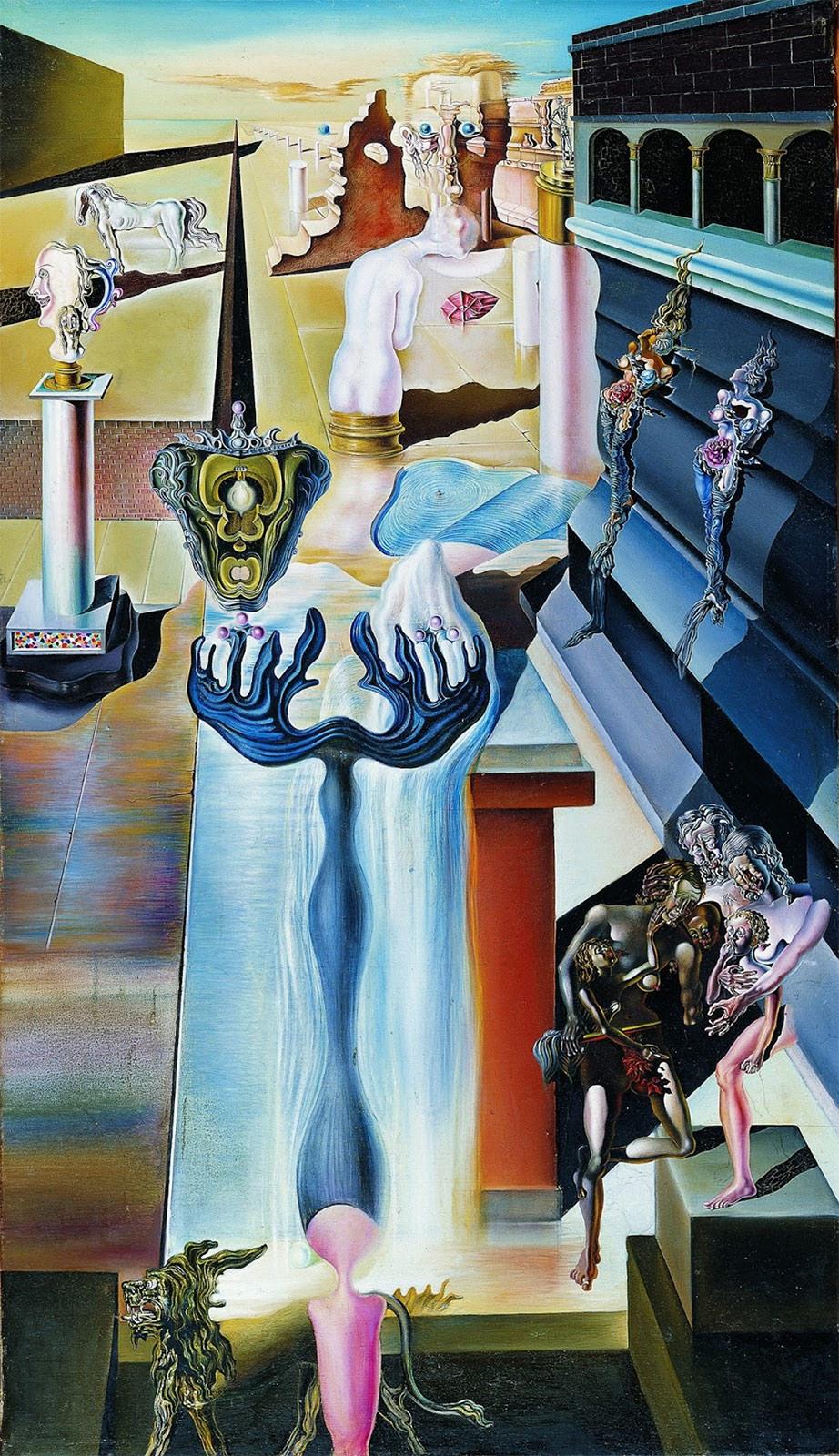
<p>Salvador Dali, L'homme invisible (The Invisible Man), oil on canvas, 1929-1932. Collection Museo Reina Sofia, Madrid</p>

Salvador Dali, L'homme invisible (The Invisible Man), oil on canvas, 1929-1932. Collection Museo Reina Sofia, Madrid

In Satire on False Perspective (1754), a print filled with errors in perspective, William Hogarth illustrated that perspective can also be used to mislead the viewer, reminding us of the importance of looking carefully and understanding the rules of perspective. In the same period, Giovanni Battista Piranesi (1720 - 1778) worked on his series of prints Imaginary Prisons which depict dizzying spaces and an infinite number of stairs, ladders, bridges, gateways and galleries. In terms of perspective, there is so much happening here that it is more or less impossible for a viewer to decide whether those spaces could actually exist.

There were other artists who used those optical illusions in their work but it wasn't until René Magritte, Salvador Dalí (1904 - 1989) and other surrealists that the optical illusion truly reappeared in the world of the arts. Dual interpretations of images was a central element in Surrealism. Dalí was genuinely fascinated by optical tricks and illusions. He used them to work multiple layers of meaning and perception in his paintings. One well-known example is The Persistence of Memory (1931) in which melting clocks suggest a distorted experience of time. Dalí also experimented with dual images, where a painting can evoke two different images, as in The Invisible Man (1939 - 1932) and Swans Reflecting Elephants (1937). He collaborated with scientists to integrate stereoscopic and holographic techniques in his art, taking optical illusions to new heights. He also made anamorphoses, a technique he learned to master so well that he could give a completely different meaning to the image that appeared in the mirror than that of the one-dimensional original. To achieve that, he looked through the cylindrical mirror while painting on the flat surface. Towards the end of his career, he took things a step further by creating duo paintings that had to be hung together, and which the viewer had to merge optically into a single image. Preferably with the aid of mirrors or a special instrument.****

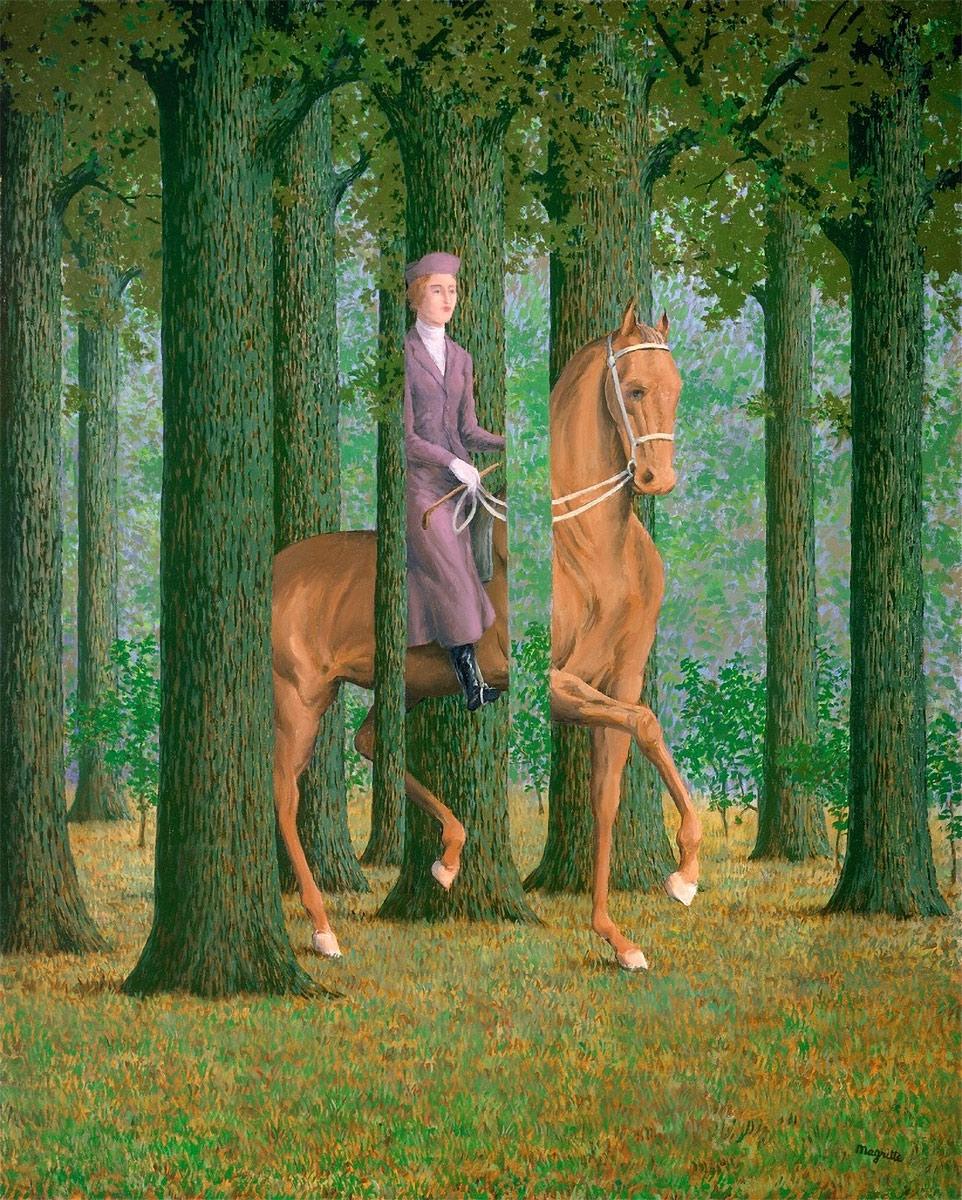
<p>René Magritte, The Blank Signature, oil on canvas, 1965. Collection National Gallery of Art, Washington DC</p>

René Magritte, The Blank Signature, oil on canvas, 1965. Collection National Gallery of Art, Washington DC

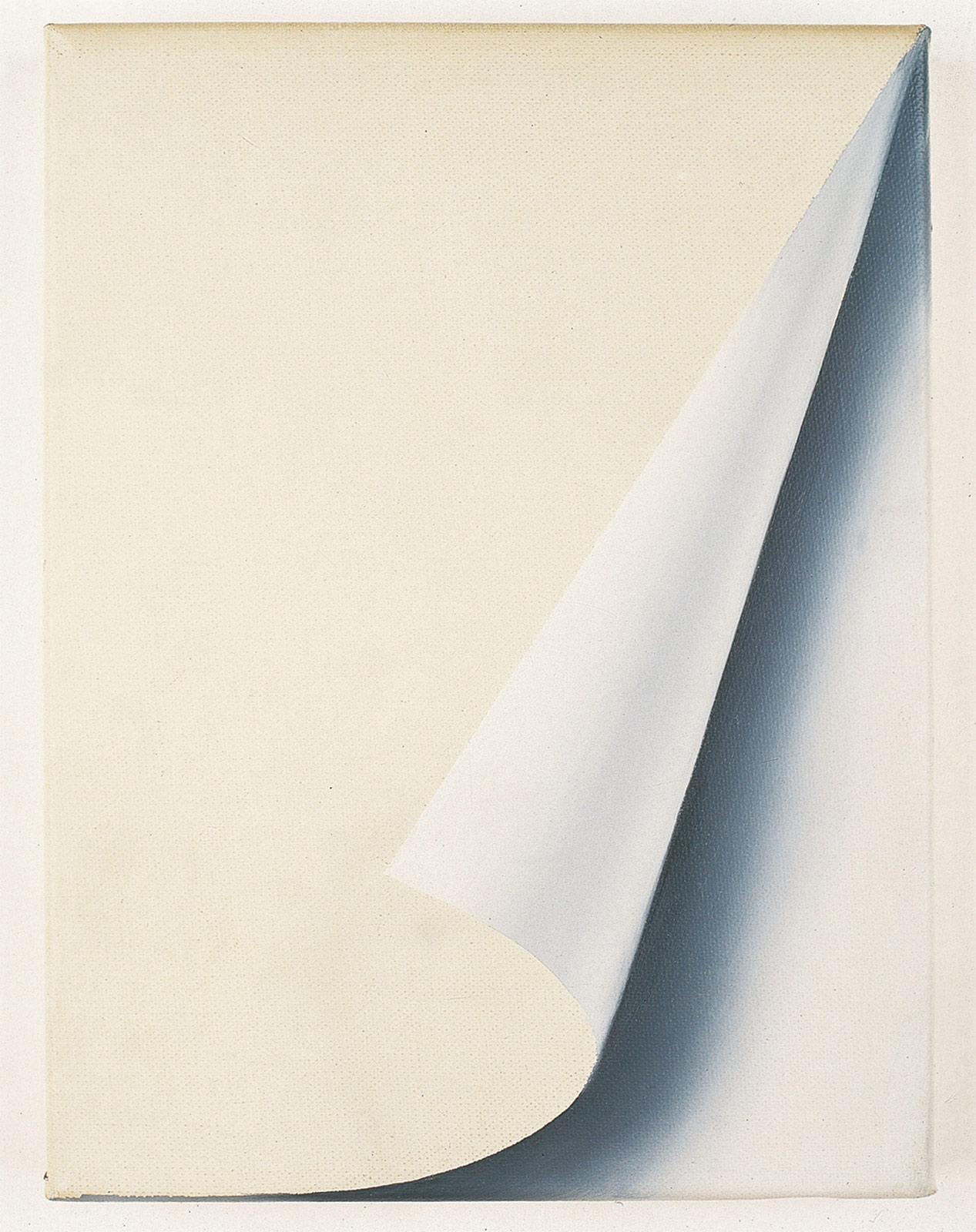
<p>Gerhard Richter, Umgeschlagenes Blatt (Turned Sheet), oil on canvas, 1965. Collection Museum Kurhaus Kleve&nbsp;</p>

Gerhard Richter, Umgeschlagenes Blatt (Turned Sheet), oil on canvas, 1965. Collection Museum Kurhaus Kleve 

René Magritte used optical illusions to call reality into question and query its existence. His paintings show everyday objects in unexpected contexts, allowing them to evoke philosophical interpretations. In the Treachery of Images mentioned earlier, he makes the difference between image and reality explicit. In other works, such as The Blank Signature (1965), he plays with perceptual contradictions and makes parts of an object mysteriously disappear or blend into the background. Magritte forces his audience to really look and reinterpret what they see. 

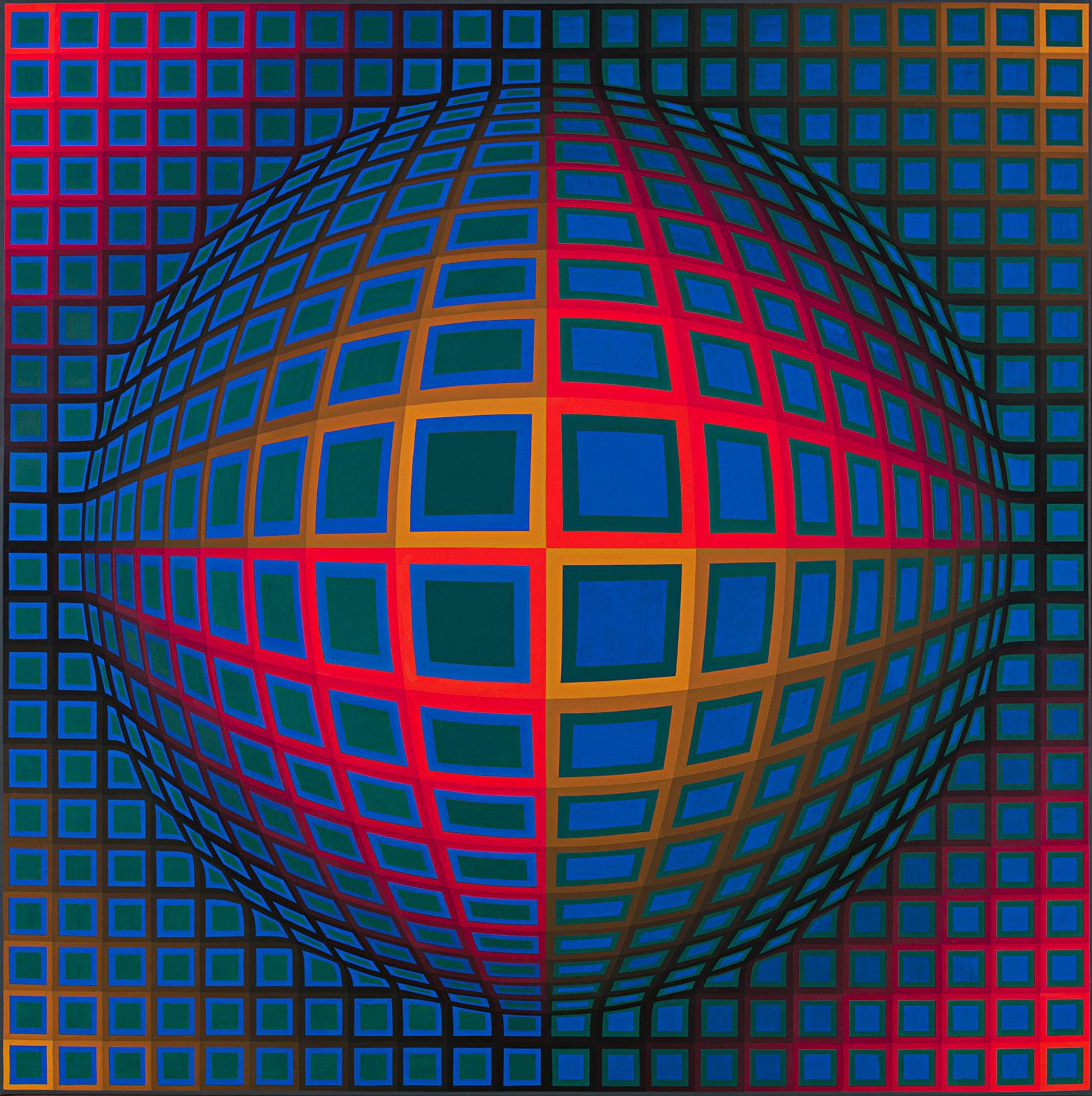
In 1965 and 1966, Gerhard Richter made a series of paintings that were all titled Turned Sheet - trompe-l'oeils that are so subtle that the illusion immediately disappears. Other 20th-century artists who focussed on fooling the eye and brain are Oscar Reutersvärd (1915 - 2002), István Orosz (1951) and Victor Vasarely (1906 - 1997). The first two did that predominantly with impossible figures and the third one with op art, work that appears to move thanks to ingenious use of lines and colours. With those artists, the illusion itself was the main focus, whereas Escher always hid it so that the experience of the illusion was delayed as it were. For example, Belvedere and Waterfall both require a second look before it becomes clear that what you're seeing is completely impossible. 

There have been more and other artists throughout the history of art who in their own way used optical illusions to challenge awareness and explore new artistic possibilities. They show us that art is not only to look at, but also to experience. It's said of M.C. Escher that he was a one-man art movement but in the case of optical illusions, that's not true at all. Although the way he used them really was unique.

<p>Victor Vasarely, Vega-Nor, oil on canvas, 1969. Collection Buffalo AKG Art Museum</p>

Victor Vasarely, Vega-Nor, oil on canvas, 1969. Collection Buffalo AKG Art Museum

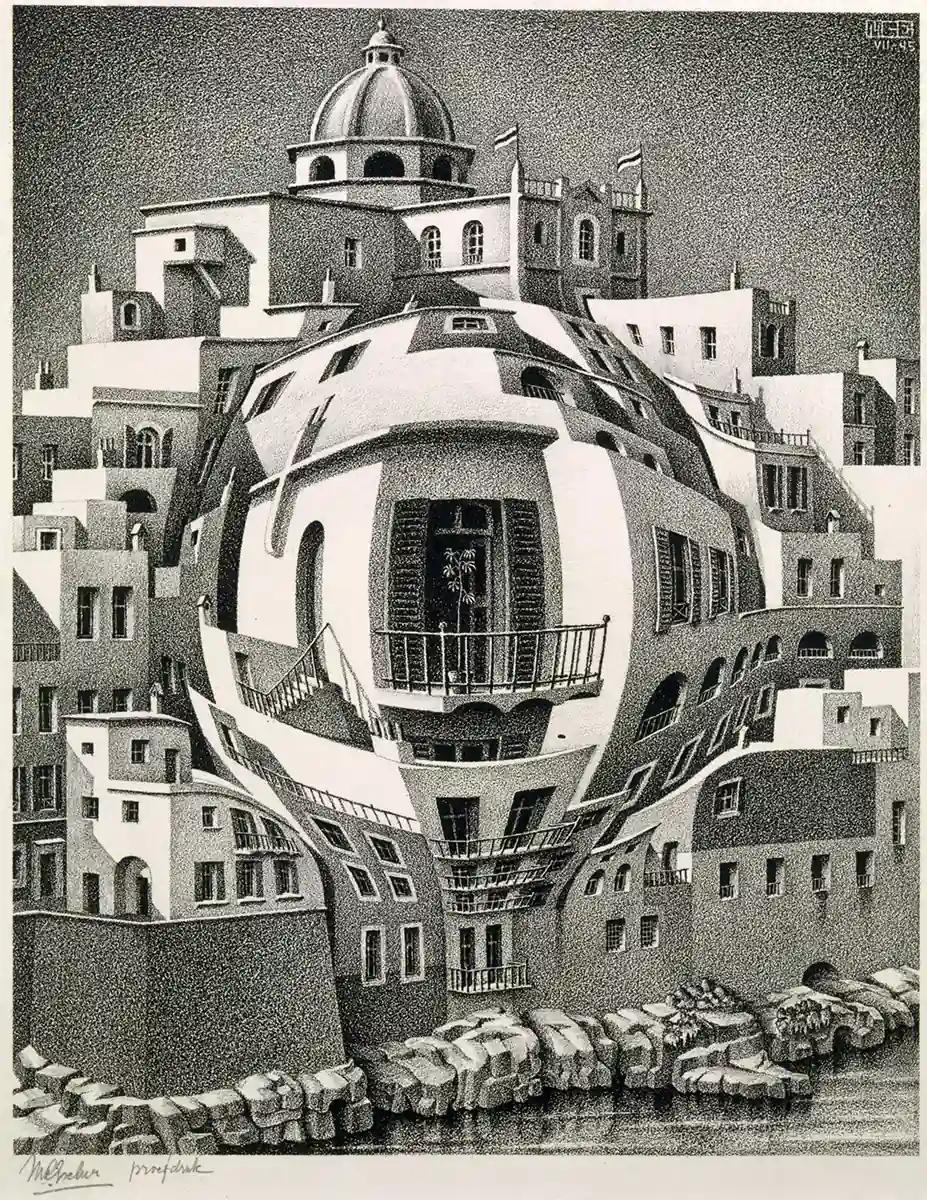
<p>M.C. Escher, Balcony, lithograph, July 1945</p>

M.C. Escher, Balcony, lithograph, July 1945

Source

[* ] The Metropolitan Museum of Art, Still Life with Grapes and a Bird: A Remembrance of Things Past
[**] Wikipedia, Science and inventions of Leonardo da Vinci
[***] Wim Hazeu, M.C. Escher, Een biografie, Meulenhoff, 1998, page 378
[****] Fundació Gala-Salvador Dalí, Salvador Dalí and science. Beyond a mere curiosity

Erik Kersten

Erik Kersten

Marketing and communications

Share:

More Escher Today

A tile tableau for and by Escher

22 November 2025

A tile tableau for and by Escher

Recently, Escher in The Palace and Kunstmuseum Den Haag were able to enrich their collection with a personal work by M.C. Escher: the tile tableau Fish and Birds from 1960, which hung in Escher's studio for many years.   

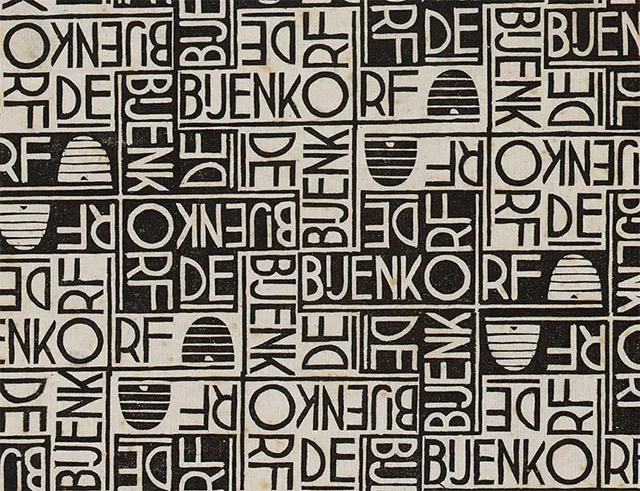
M.C. Escher's Word-Puzzle Wrapping Paper for De Bijenkorf

18 October 2025

M.C. Escher's Word-Puzzle Wrapping Paper for De Bijenkorf

Doris Schattschneider, Escher expert and retired professor of mathematics, was a guest speaker at the annual Bridges mathematics conference. This year, the conference was held in Eindhoven in July. She presented her research into Escher's design for wrapping paper for the Bijenkorf department store, for which Escher turned to his hobby of what he called "word-puzzles".