In the first half of the twentieth century, Escher lived in Rome with Jetta and their children. Although Escher was enamoured with the Italian landscape, this period proved to be a difficult one for him and his family. The first half of the twentieth century in Italy was characterised by the rise and, later, the dominance of Benito Mussolini’s (1883–1945) Fascism. In this edition of ‘Escher Today’, you can read more about what Fascism entailed, what it meant for the arts, and why it posed such a challenge for Escher and his family.
Escher loved Italy’s mountainous landscape; he would travel there every spring, after which he would translate his impressions into prints during the autumn and winter. He would have preferred to live there for the rest of his life, but things were not made easy for him and his family. Selling his works in Italy proved to be very difficult, particularly because Mussolini had called for art to be placed at the service of Fascism. Escher’s landscape prints did not meet that requirement. For that reason, in the early 1930s he spent more time in the Netherlands, selling his work there and arranging exhibitions and commissions, such as creating the illustrations for Jan Walch’s book The Terrible Adventures of Scholastica. The work he found in the Netherlands proved to be more lucrative for him than selling his prints in Italy.
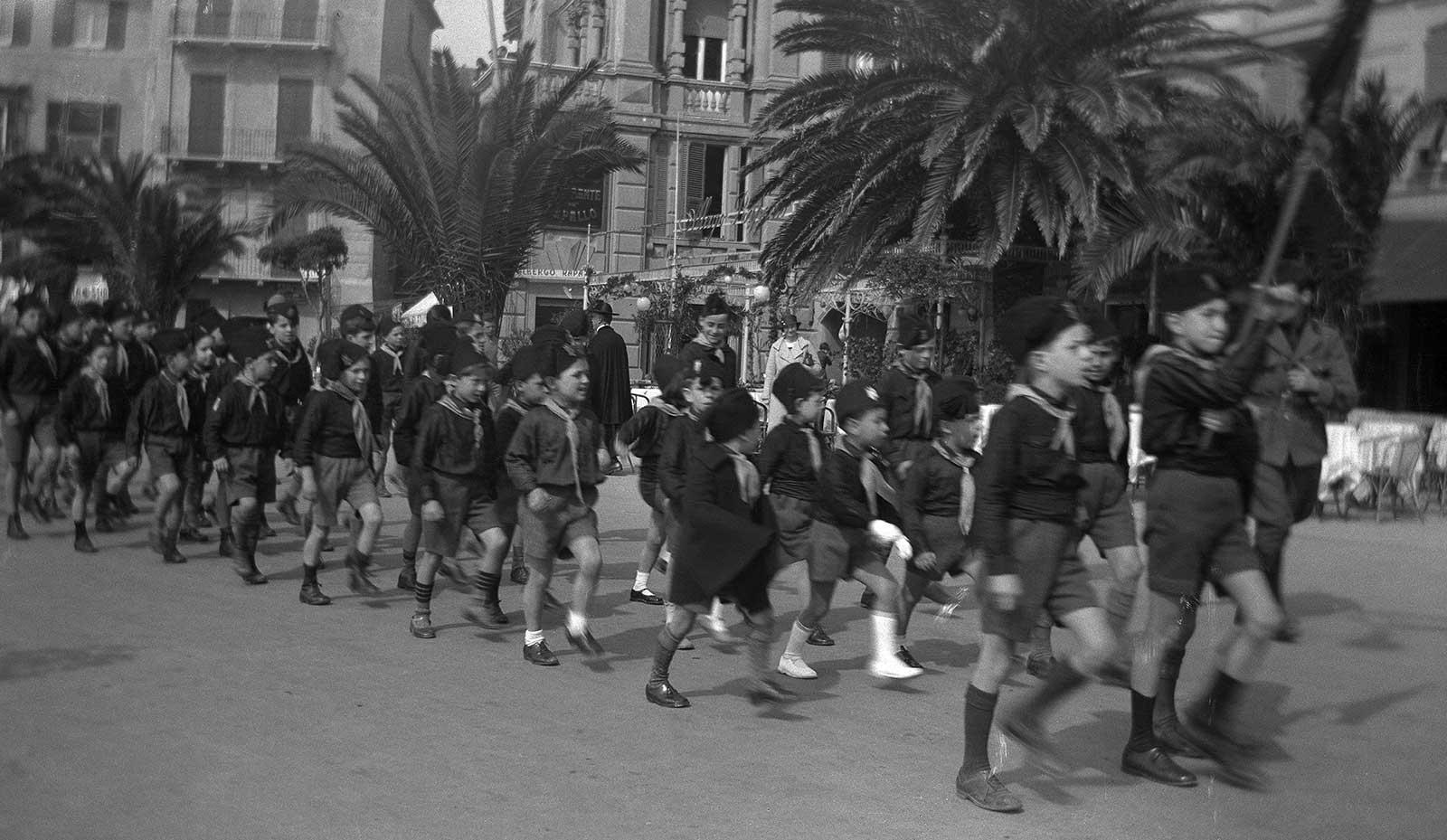
Son George (striped socks, slightly to the left of centre) amongst the Balilla, 2 April 1933
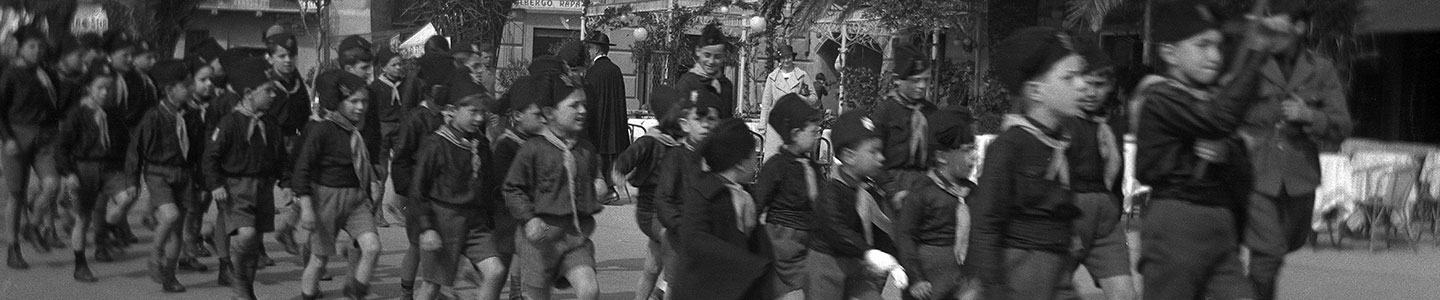
However, the growing influence of the fascist regime was not confined to the artistic sphere. In other respects, too, it became increasingly difficult for Escher and his family to remain in Italy. Not only was the deadly disease tuberculosis rife, but Mussolini’s fascist grip on schools was also being steadily extended. Escher and Jetta had already found this very troubling when they lived for a while in Rapallo, east of Genoa, in 1933. There, their son George was required to march alongside other schoolchildren with the Balilla, the Fascist youth movement. Because his parents did not want him to march in full uniform, George wore only the black fez with the dangling cord ‘by way of compensation’.*(1)
These political developments also coincided with personal concerns within the family. During the same period, their son Arthur was diagnosed with tuberculosis, which meant he could not attend school. And when tuberculosis bacteria were detected in Arthur again in 1935, doctors strongly recommended a long stay in the mountains. Although leaving Rome was therefore in any case beneficial for Arthur’s physical health, it also became increasingly clear that Fascism was not going to disappear any time soon.*(2) In August 1935, the Escher family finally left Italy for good, a year before Mussolini formed an alliance with Adolf Hitler’s (1889-1945) NSDAP. They would continue to live in Switzerland until July 1937.
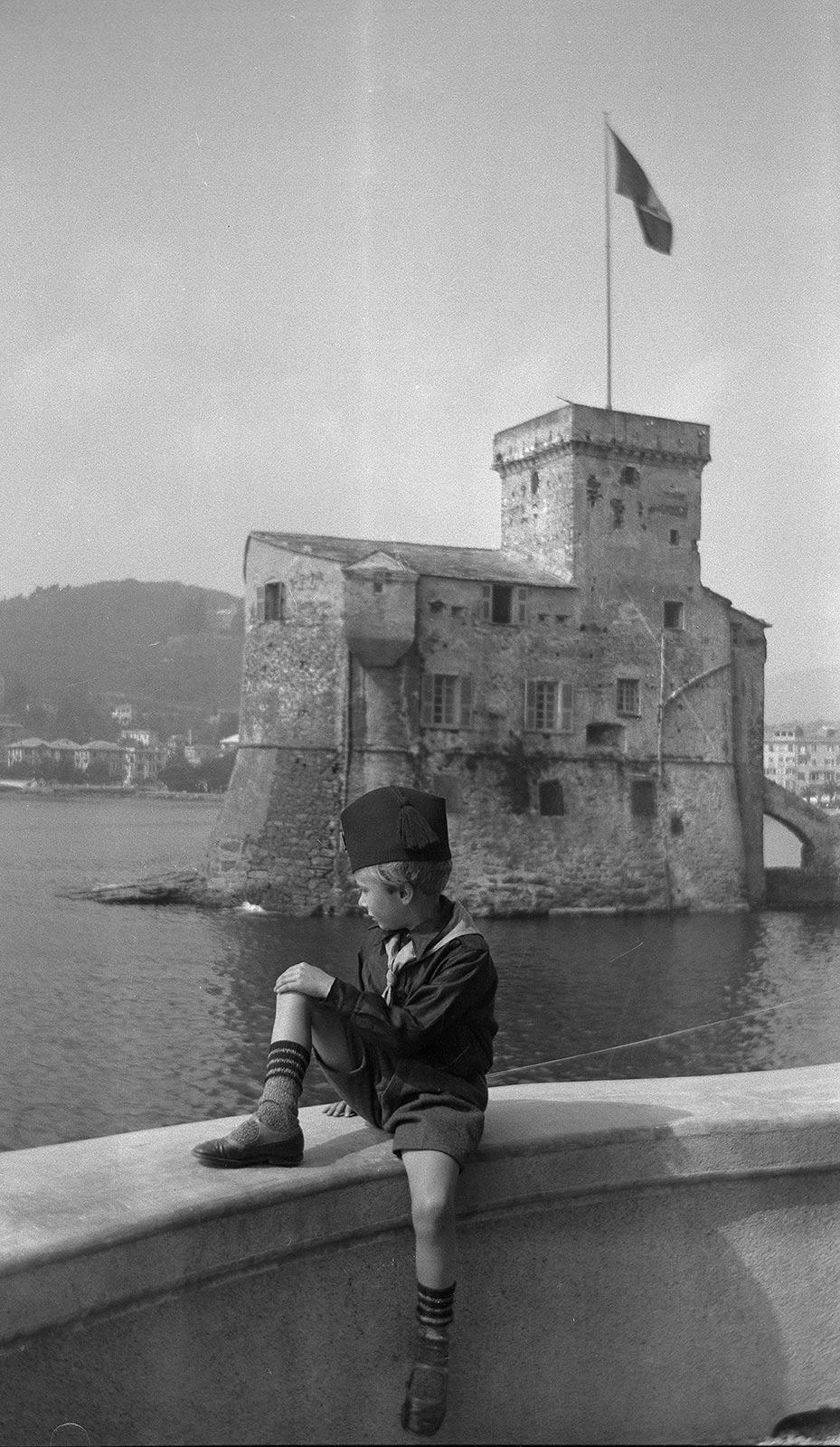
Son George at ‘Rapallo Castle’, 2 April 1933
Fascism and the arts
To better understand the social and political circumstances Escher encountered in Italy, it is important to consider the origins and characteristics of Fascism. The movement has its origins in the Fasci di Combattimento (1919), a group founded by Benito Mussolini. The name ‘Fascism’ derives literally from this.*(3) In 1922, Fascism was established as a political system in Italy under the leadership of Mussolini, who had himself referred to as Il Duce (‘the leader’). He would hold power over Italy from 1922 to 1943.*(4) Although the term ‘fascism’ has taken on a somewhat fluid meaning over the years and is also used to refer to related political ideologies, Italian Fascism is characterised by nationalism and militarism. The ideology is also anti-democratic: it places the nation above the individual and turns its back on traditional politics. The concrete consequence of this was that Mussolini became a dictator and built a system that legitimised violence and employed propaganda and censorship to overshadow political views other than those of Fascism. Consequently, Fascism in Italy also had a significant influence on the art produced (more on this later). At the same time, the ideology drew much inspiration from an artistic movement: Futurism.
Futurism was an avant-garde movement that perfectly illustrates the relationship between politics and art. The movement flourished in Italy between 1906 and 1916 and produced artists such as Giacomo Balla (1871-1958), Gino Severini (1883-1966), Luigi Russolo (1885-1947) and Filippo Marinetti (1876-1944).*(5) The term ‘Futurism’ derives from the Italian futuro (future) and has as its ideal a complete break with all tradition, in order to build an entirely new system. This new world would encompass all spheres of society and strive for individual freedom. However, by ‘individual’, the Futurists primarily meant ‘man’, as masculinity was very important to them.*(6)
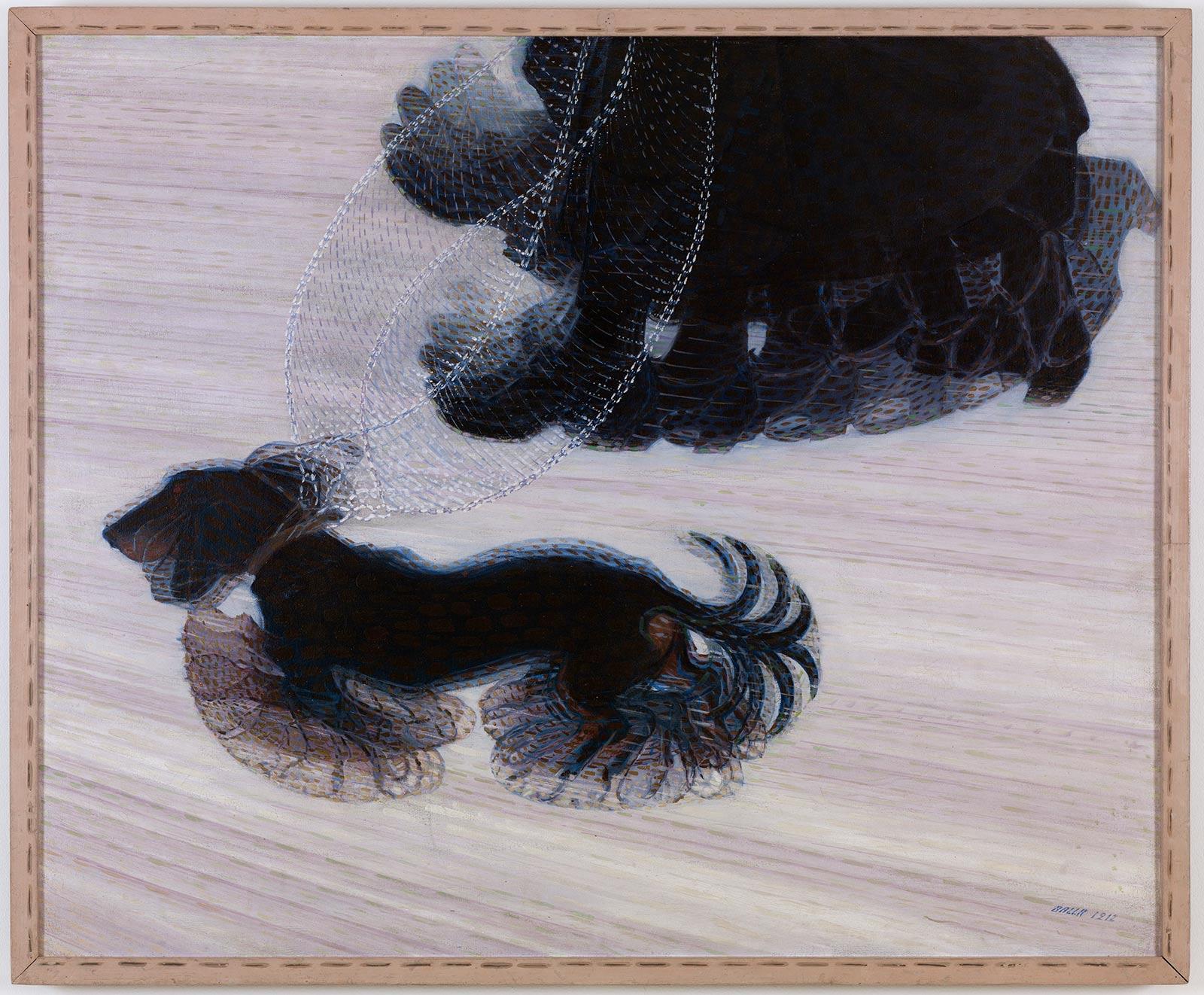
Giacomo Balla, Dynamism of a Dog on a Lead (Dinamismo di un cane al guinzaglio), 1912, Buffalo AKG Art Museum, Buffalo
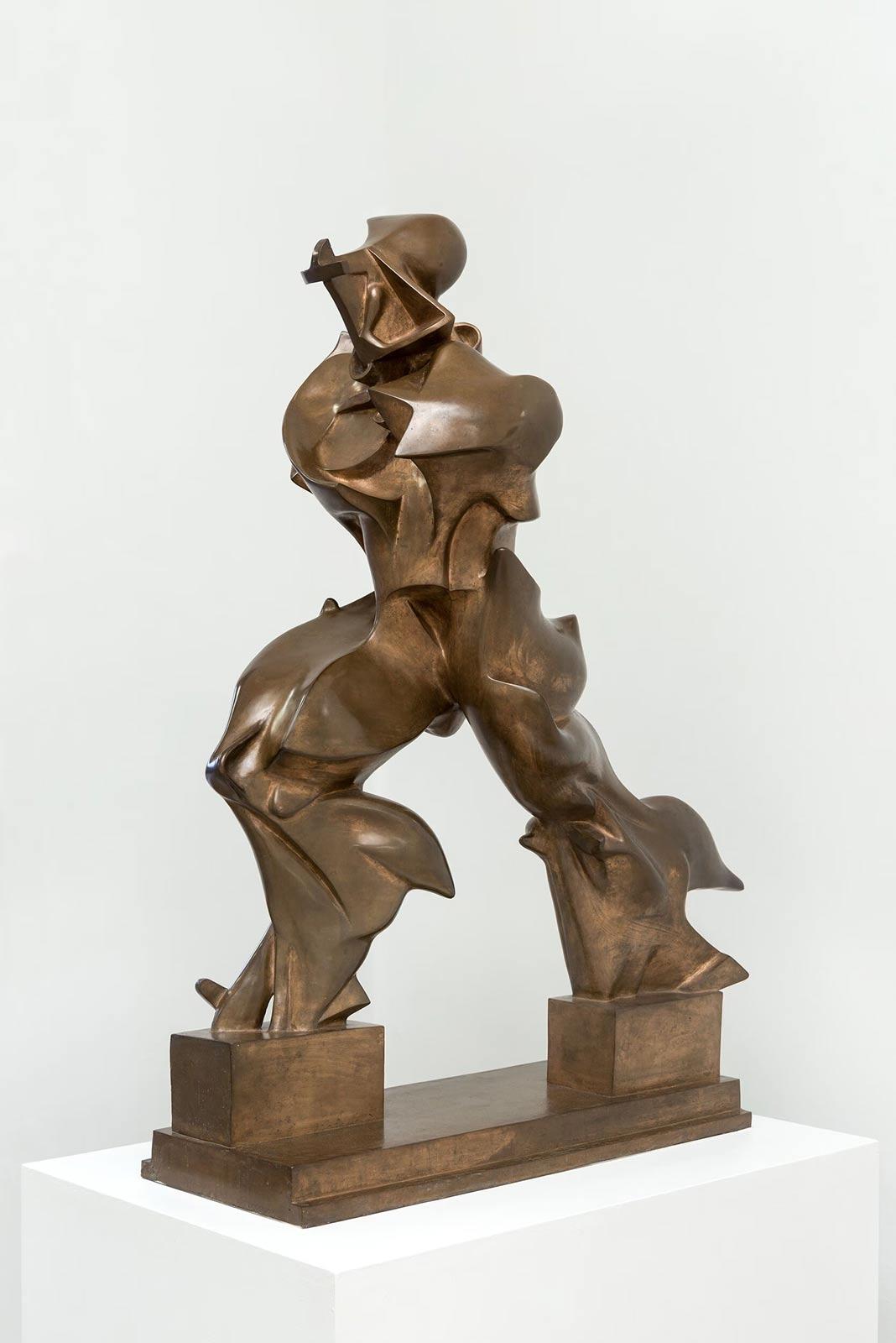
Umberto Boccioni, Unique Forms of Continuity in Space (Forme uniche della continuità nello spazio), 1913, Kröller-Möller Museum, Otterlo
Within this movement, Filippo Marinetti in particular played a central role. Marinetti was something of a figurehead of Futurism; in 1909, he had published the Futurist Manifesto, which formed the basis of the movement.*(7) In the manifesto, he set out what was important within Futurism. For example, Marinetti speaks of ‘a love of danger’, the ‘glorification of aggressive action’, the importance of looking to the future rather than the past, and also: 'We affirm that the splendour of the world has been enriched with a new beauty: the beauty of speed. A racing car whose bonnet is adorned with large exhaust pipes, like snakes with explosive breath – a roaring car that seems to run on bullets is more beautiful than the Victory of Samothrace.'
The ideas set out in this manifesto were subsequently reflected in the movement’s visual art and music. The splendour of speed that Marinetti describes here is also evident in Futurist art. See, for example, some of the best-known works shown above. Fascinated and impressed by all manner of new inventions, such as the first cars and aeroplanes, the Futurists sought to capture the new dynamism of speed and movement in their art. Futurism was not merely visual; the movement was about a completely new attitude to life.*(8) That is why even things such as the sounds of the new modern age were translated into musical compositions, as in, for example, Russolo’s Risveglio di una Città (‘Awakening of a City’; 1913).*(9)
It is precisely this new outlook on life that explains why Futurism and Fascism later found common ground so easily; many of their ideas were closely aligned. When Mussolini came to power, Futurist artists became popular within his regime.*(10) Years before Mussolini’s dictatorship, Marinetti was already hailing “Mussolini is a Futurist!”, after Mussolini had been expelled from his political party because of his pro-war stance – a stance which the Futurists shared with him.*(11)
The close connection between the two movements subsequently found its way into the regime’s official cultural policy. Art played a significant role in Mussolini’s dictatorship. As mentioned earlier, Mussolini used propaganda to overshadow ideologies other than his own. Part of this involved controlling Italy’s art and culture. In practical terms, this meant that artists were encouraged (or forced) to create art that glorified the Italian state; in other words, art that was nationalistic. Fascism did not have a ‘state style’ but was based on a symbiosis: styles, movements and views that supported the regime could count on being appreciated.*(12) However, if you did not do this, your art would not be accepted. For Escher, the consequences of this eventually hit very close to home. Although he harboured a deep love for Italy and its landscapes, his work did not fit within the cultural ambitions of the Fascist regime. Combined with concerns about his children’s health and upbringing, this made a future in Italy increasingly untenable, leading to the family’s definitive departure in 1935.
References
*(1) Wim Hazeu, M.C. Escher, Een biografie, Meulenhoff, 1998, p.156
*(2) Wim Hazeu, M.C. Escher, Een biografie, Meulenhoff, 1998, p.173
*(3) Falasca-Zamponi, S. (1997): Fascist Spectacle. The Aesthetics of Power in Mussolini's Italy, University of California Press, pp. 95-96
*(4) De Dictators: Mussolini
*(5) and *(7) Exhibition Futurism & Europe
*(6) Historisch Nieuwsblad
*(8) The Futurist Manifesto
*(9) Luigi Russolo - Awakening of a City
*(10) Giacomo Balla
*(11) Historisch Nieuwsblad
*(12) Nieuwe kunst voor een nieuwe politiek