This website uses cookies

We use cookies and similar technologies on this website to analyze visits and to show you relevant messages on social media. By clicking 'Accept all' you give permission for their placement and for the processing of personal data obtained in this way, as stated in our privacy & cookie statement.

Our privacy & cookie statement:

A Remarkable Collaboration
4 July 2026

A Remarkable Collaboration

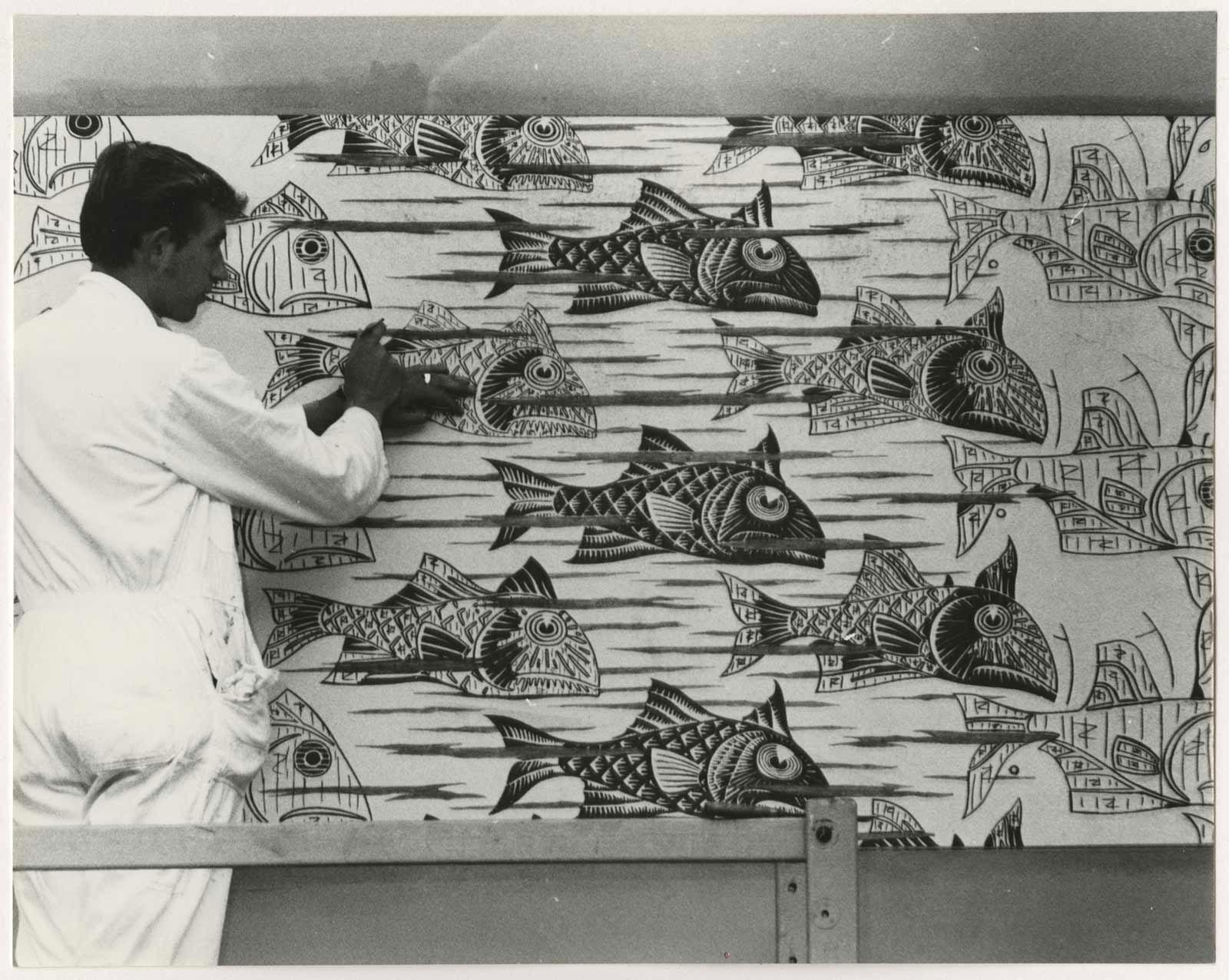
Painting apprentice Huug Vooys was 19 when he was invited to take part in an exceptionally special project: a mural no less than 48 metres long in the main PTT building, the post office on Kerkplein in The Hague. The design was by none other than M.C. Escher, who himself noted that he had possibly received "a most delightful commission" from the PTT.* The large work was realised, but Escher did not execute the design himself - the honour fell to Huug Vooys.

The PTT approached Escher to design a mural based on his print Metamorphosis II (1939–1940). However, the four-metre-long composition had to be extended in order to reach the desired length of 48 metres. In a letter to his son dated 11 June 1967, he wrote of this task:

"A new, enormous post office in The Hague has a counter hall with a wall surface above it measuring 48 m in length. This must be decorated with a kind of frieze approximately 1.60 m high. The aesthetic adviser of the PTT would like to use my old Metamorphosis for this purpose, photographically enlarged and then painted on the wall (not by me!, but by a skilled craftsman). However, my Metamorphosis is only 20 cm high and 4 m long. At a height of 1.60 m, the length would therefore be only 32 metres. I must therefore add another 16 metres, or - in terms of the original scale of the woodcut strip - add or insert another 2 metres of new metamorphoses. That should be possible, but it is quite an undertaking."*

In 1967 and 1968, Escher spent roughly six months designing and executing the additional segments that would ultimately become Metamorphosis III (1967–1968). The project thus evolved from the first version of the print he made in 1937 into a greatly enlarged work that, more than thirty years later, would occupy an entire wall in a monumental hall.

For the realisation of the large-scale mural, the young painting apprentice from Katwijk, Huug Vooys, was selected. Eisema’s Schildersblad devoted considerable attention to this commission, given the great responsibility entrusted to the apprentice: "the opportunity of a lifetime."** Initially, the painting firm involved was hesitant to accept the assignment due to its exceptional nature and scale. However, Escher placed great importance on a precise and neutral execution of his design and wanted to prevent an autonomous artist from adding a personal interpretation. The commission did not require artistic reinterpretation, but rather a technically exact translation of an existing visual concept into monumental form. Once it became clear that the role was strictly executory, the assignment was accepted.

Escher stipulated that the work be carried out by a single painter to ensure consistency in style and finish. This gave Vooys the chance, while still in training, to realise a work of exceptional size and visibility. Vooys was employed by the painting firm Hoval from Valkenburg and had already distinguished himself there, fitting the required profile well.

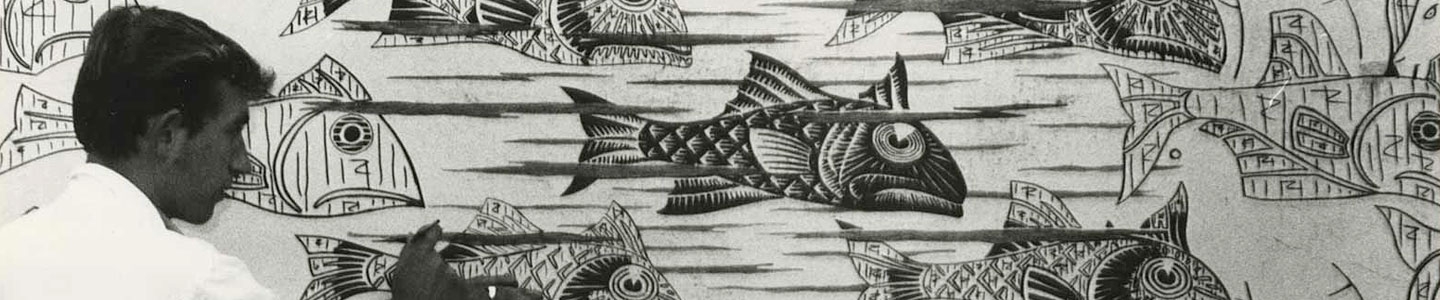
<p>Huug Vooys working on the painted Metamorphosis III. Photo: Hans de Bakker collection The Hague Municipal Archive</p>

Huug Vooys working on the painted Metamorphosis III. Photo: Hans de Bakker collection The Hague Municipal Archive

A Technical Challenge

Preparing the mural took almost a year, as it involved both conceptual adjustments and technical challenges. Escher had to extend the original design of Metamorphosis II to fill the entire wall, after which the new version needed to be enlarged by a factor of 6.45 to reach a total length of 48 metres and a height of 1.20 metres. This enlargement posed considerable technical difficulties.

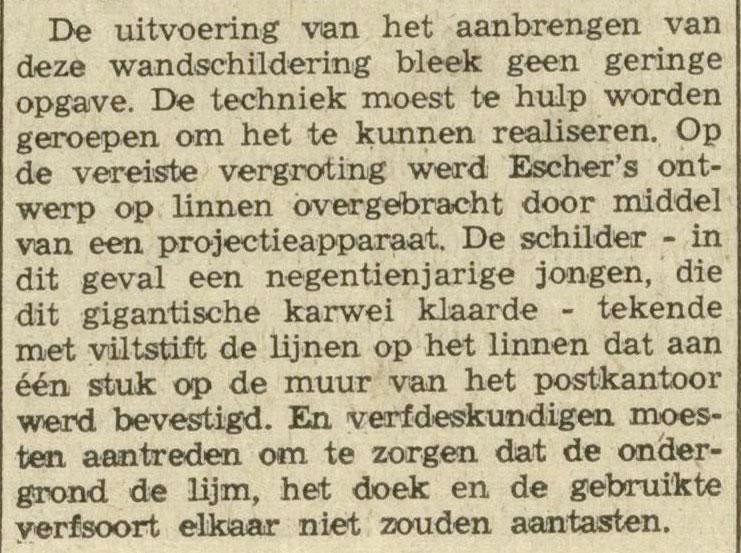
To transfer the design accurately, an episcope - a projector used to display flat objects such as photographs and drawings - was employed. This device was specially acquired for the project and installed in the basement of the post office, known as the "atomic cellar". Escher’s design was mounted on large reels and gradually fed beneath the episcope, while an enlarged projection appeared on one of two lengths of linen rolled onto spools. Each projected section was carefully traced with a felt-tip pen, after which Vooys applied the colours with a fine brush.

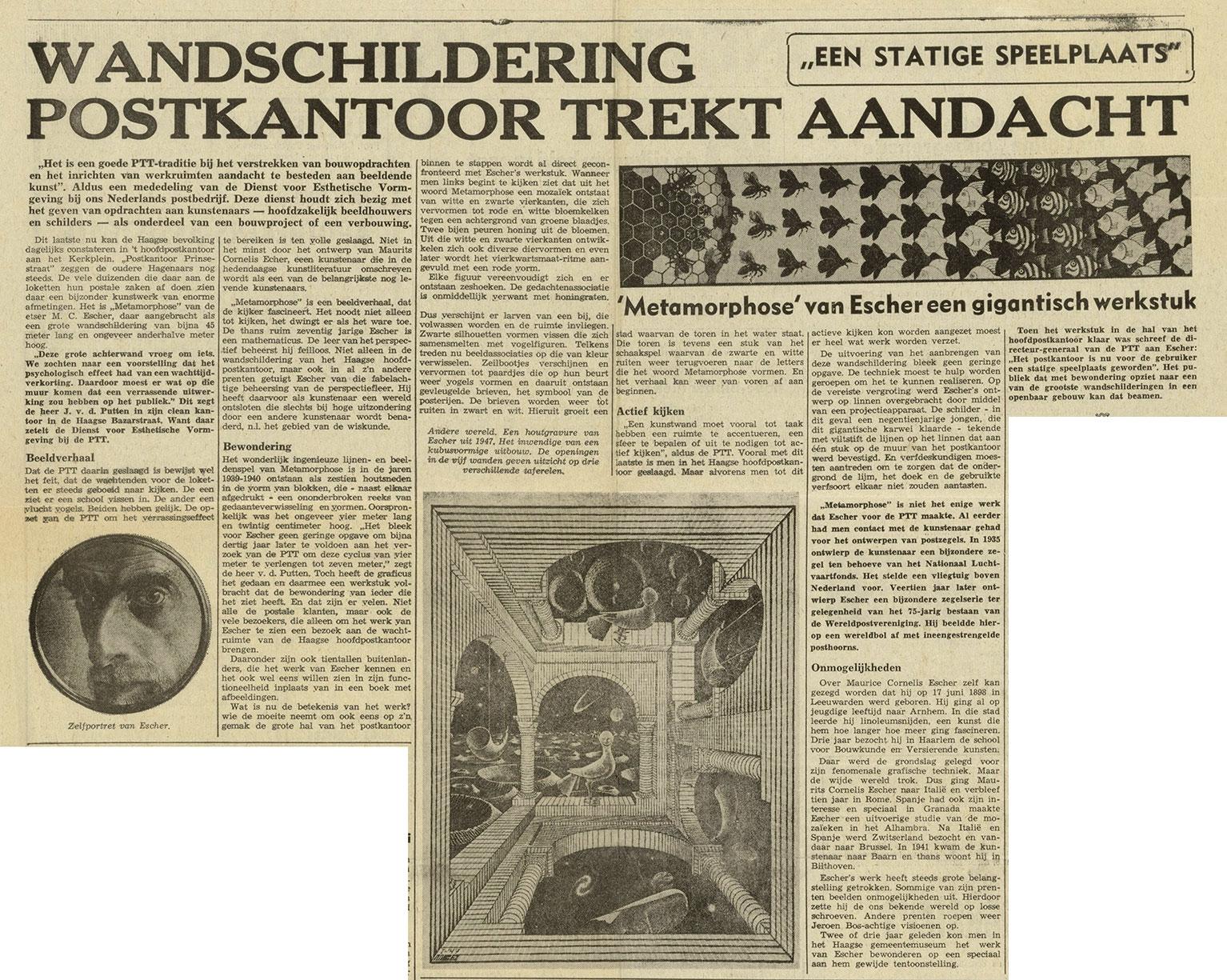
<p>Dutch newspaper 'De Posthoorn', 24 June 1971</p>

Dutch newspaper 'De Posthoorn', 24 June 1971

Ultimately, the painting was mounted on the wall in three sections, each sixteen metres long. Escher visited regularly to monitor progress. In mid-May 1968, he wrote to his son George that he had recently visited the post office in The Hague. He noted that little progress had been made so far but also wrote: "[…] but the young journeyman painter (21) is doing it extremely well and with great pleasure. It will still take half a year before it is completely finished."*** Although Escher did not know his exact age, this passage shows his satisfaction with the young painter’s abilities.

While the mural was being executed, the post office remained open to visitors. This did not disturb Vooys, who calmly continued his work, as described in Eisema’s Schildersblad in October 1968. The article also paints a clear picture of the collaboration between Vooys and Escher: "Escher composed these visible sounds; Vooys performed them. The former could not have wished for a better interpreter. Tribute to both artist and executor. Vooys worked just as seriously and meticulously as the composer required - and that is saying a great deal." So there was an amicable atmosphere between the two, something also confirmed in Escher’s letter to his son George. 

As a token of appreciation, Escher presented Vooys with a fragment of the print, on which he wrote in pencil:

"For Huug Vooys, this fragment of Metamorphosis, as a small token of great appreciation for many months of skilful and meticulous work. The Hague."****

The Unveiling

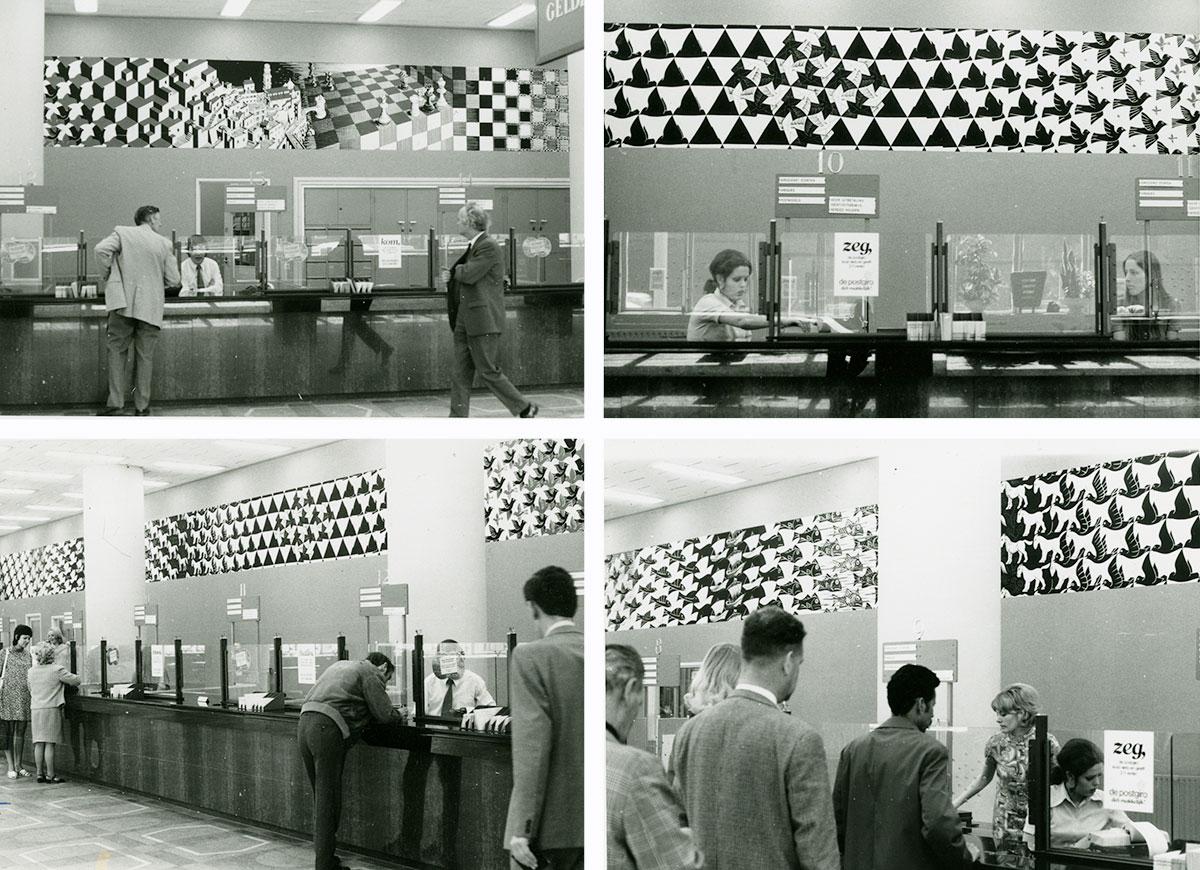
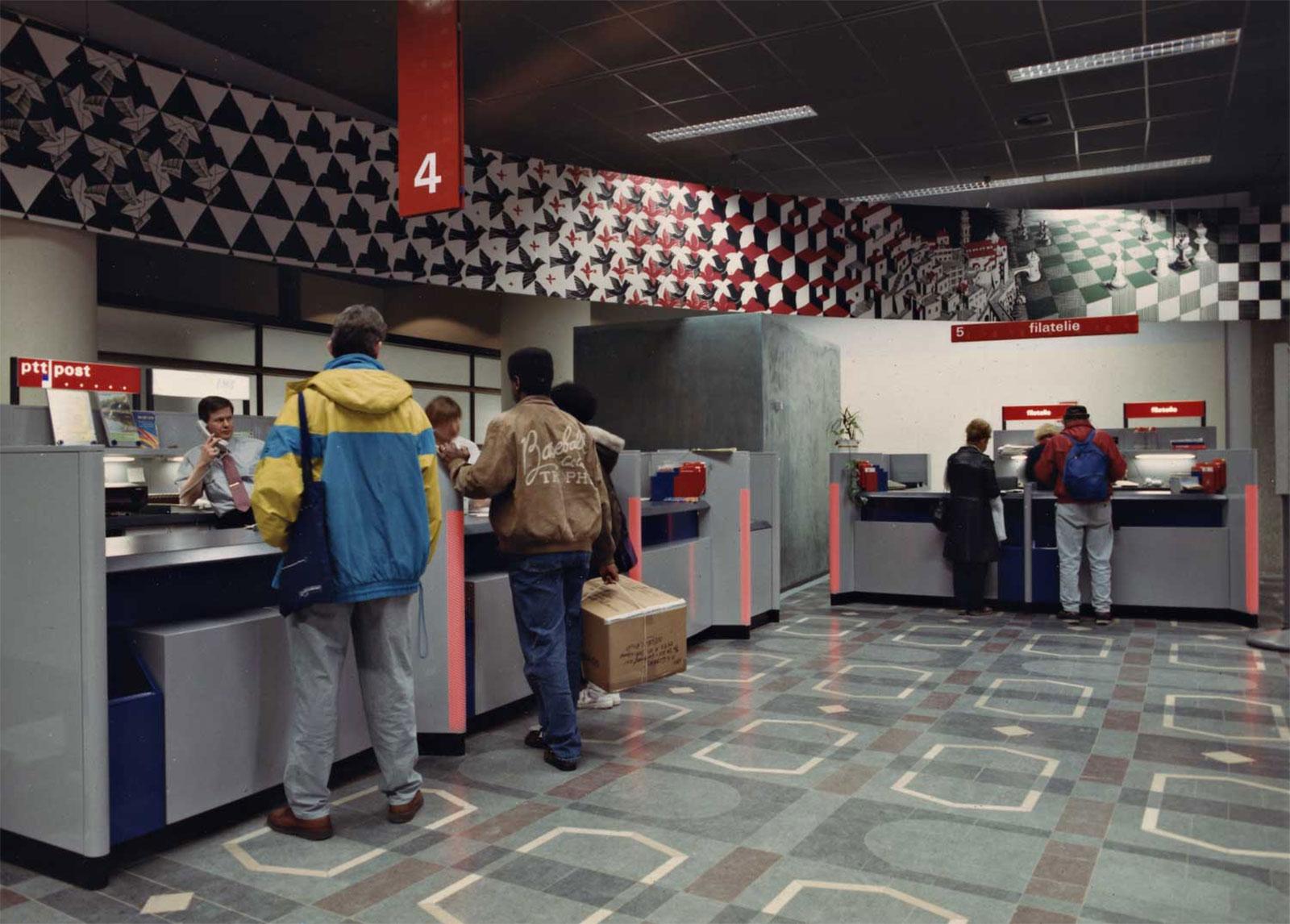
The monumental Metamorphosis was unveiled on 20 February 1969 in the presence of numerous high-ranking PTT officials. The final mural was characterised by smooth transitions between forms, motifs, and blocks of colour. Escher’s visual transformations - from animals to architecture and abstract patterns - were expressed with clarity and accessibility on an impressive scale.

Although the post office no longer exists, the artwork can still be admired at Schiphol Airport. Thanks to the hard work of Huug Vooys, Escher’s Metamorphosis can be enjoyed on a grand scale. We are grateful for his contribution to one of Escher’s most remarkable works and acknowledge his skill, dedication, and expertise.

<p>The central public area with the service counters, above which runs Escher's Metamorphosis. Collection Beeld en Geluid Den Haag | Photographer unknown | 1990s</p>

The central public area with the service counters, above which runs Escher's Metamorphosis. Collection Beeld en Geluid Den Haag | Photographer unknown | 1990s

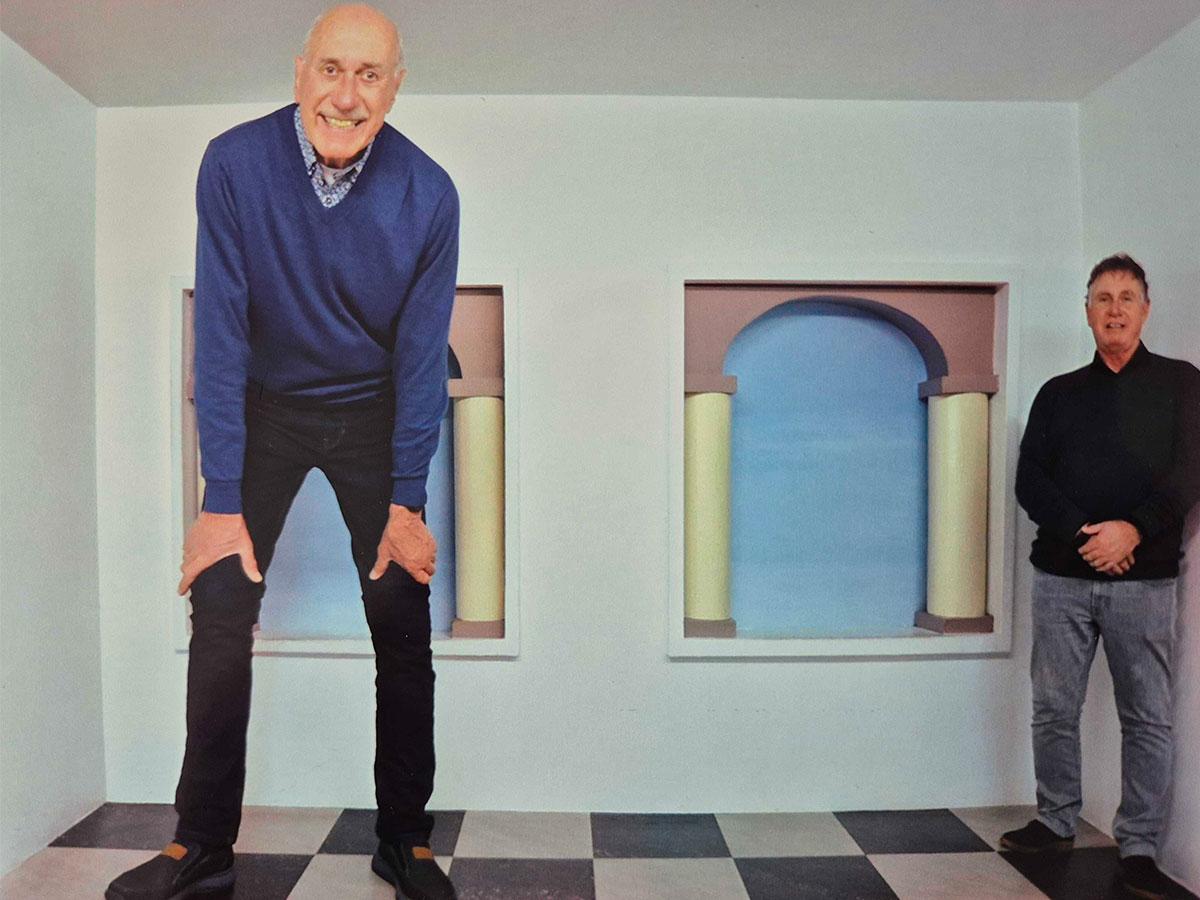
<p>Huug Vooys (left) during a visit to Escher in The Palace, 2023</p>

Huug Vooys (left) during a visit to Escher in The Palace, 2023

Sources

* Letter from M.C. Escher to George and Corrie Escher, 11 June 1967
** This account is based entirely on coverage by: G.W.H., ‘Leerling-schilder H. Vooys schildert Wandschildering van 48 m lengte in het Haagse hoofdpostkantoor’, Eisma’s schildersblad 70 (16 October 1968) no. 25, pp. 964-968 & Anonymous, ‘Wandschildering postkantoor trekt aandacht. Metamorphose van Escher, een gigantisch werkstuk’, De Posthoorn, 24 June 1971.
*** Letter from M.C. Escher to George and Corrie Escher, 19 May 1968
**** Christie’s auction, 17 November 2009 [Lot no. 00183]

Written with thanks to Teddy Berends

Mireille Linck

Mireille Linck

Curator

Share: